Nikola Tesla VS Thomas Edison
“The War of the Currents”: Who Was the Real Genius and Who Was the Marketer?
The history of humanity is filled with rivalries, but few have reshaped the future of our world as dramatically as the intellectual and commercial battle between two brilliant inventors: Nikola Tesla and Thomas Edison. History remembers this fierce clash as “The War of the Currents.”
Today, when electricity is an inseparable part of our daily lives, a fundamental question is often raised: Who between these two was the true scientist and genius, and who was simply a gifted marketer and businessman?
Let us travel back to the late 19th century and dive deep into this dramatic story full of intrigue, ambition, and ruthless competition.

The Beginning of a Great Rivalry: The Employer and the Penniless Immigrant
In 1884, a young, energetic Serbian immigrant arrived in the United States. His name was Nikola Tesla. He stepped off the ship with only four cents in his pocket, a few poems, and a letter of recommendation addressed to Thomas Edison. The letter, written by Edison’s business associate, read:
“My dear Edison, I know two great men in this world. One is you, and the other is this young man.”
Edison hired Tesla on the spot, but their partnership was doomed from the very beginning. They represented two entirely different universes:
- Thomas Edison was a practical man who achieved results through a brutal process of trial and error. He was willing to run thousands of experiments until he stumbled upon the desired outcome.
- Nikola Tesla was a visionary theoretician and a phenomenal visualizer. He could construct entire machines in his mind, run them, and fix their flaws without ever drawing a single blueprint.
The $50,000 Lie
The breaking point in their relationship came when Edison asked Tesla to improve his inefficient Direct Current (DC) generators, promising a reward of $50,000 (equivalent to over $1 million today). Tesla worked tirelessly and solved the problem brilliantly. However, when he asked for his earned reward, Edison scoffed and replied: “Tesla, you don’t understand our American humor.”
Deeply betrayed, Tesla resigned that very day. For a period, he was forced to perform manual labor, even digging ditches just to survive.
Direct Current (DC) VS Alternating Current (AC)
After leaving Edison, Tesla achieved what he had been dreaming of for a long time—he perfected the Alternating Current (AC) system. This sparked the true “War of the Currents.”
Humanity stood at a crossroads between two completely different technologies:
| Features | Thomas Edison: Direct Current (DC) | Nikola Tesla: Alternating Current (AC) |
| Working Principle | Electrons flow steadily in only one direction. | Electrons periodically reverse direction. |
| Distance Limit | Could only transmit power effectively up to 1-2 kilometers. Required a power station every two kilometers. | Thanks to transformers, power could be transmitted across thousands of kilometers. |
| Commercial Side | Expensive and inconvenient, but Edison held countless lucrative patents on it. | Cheap, highly efficient, and easily accessible to everyone. |
Tesla found a powerful ally in George Westinghouse, a wealthy industrialist who bought Tesla’s patents and began the mass implementation of Alternating Current. Edison quickly realized that his multi-million dollar empire was under immense threat.
Black PR and Horrific Experiments
Since Edison was losing the technological battle, he shifted his strategy to fear, disinformation, and aggressive black marketing. His primary goal was to convince the public that Tesla’s alternating current was deadly and unsafe.
Edison began organizing public demonstrations where he used alternating current to electrocute and kill stray animals, including cats, dogs, and horses, in front of shocked crowds.
Topsy the Elephant and the Electric Chair
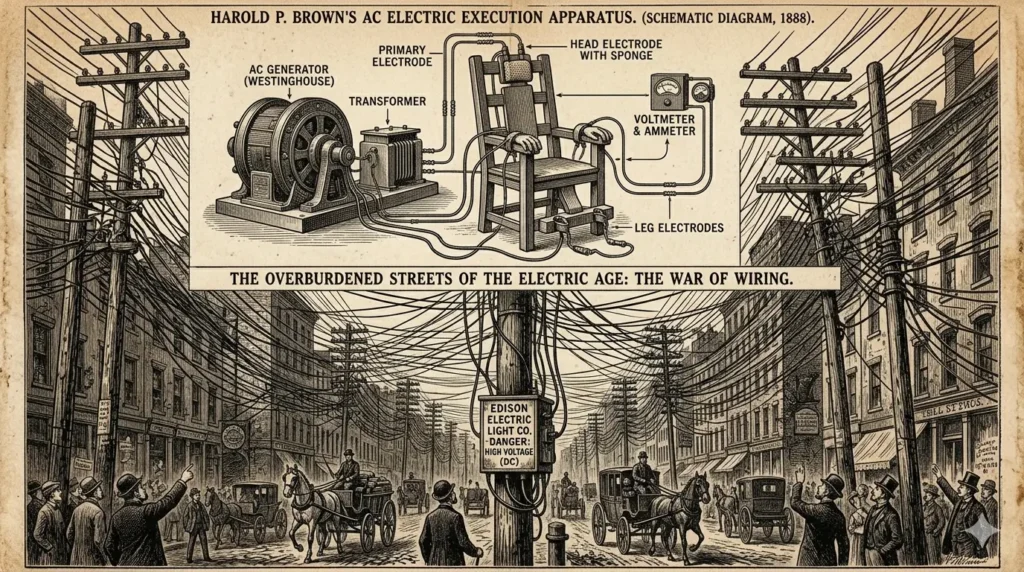
The most tragic episode of this corporate war occurred in 1903. Edison publicly electrocuted Topsy, a circus elephant, using alternating current. He brought film cameras to capture the horrific event, aiming to visually tie Tesla’s system to lethal danger.
Furthermore, Edison secretly funded the invention of the world’s first electric chair for execution. He insisted that the process of execution by electricity be called “being Westinghouse’s,” hoping the phrase “alternating current” would become permanently synonymous with death in the public consciousness.
Tesla’s Response: Showmanship and the Triumph of Light
Nikola Tesla fought back against cruelty and aggressive PR with science and pure showmanship. He began holding public lectures where he passed high-frequency alternating current through his own body, lighting up bulbs held in his bare hands. Through this, he proved that when used correctly, alternating current was completely safe.
Two major events put a definitive end to the War of the Currents:
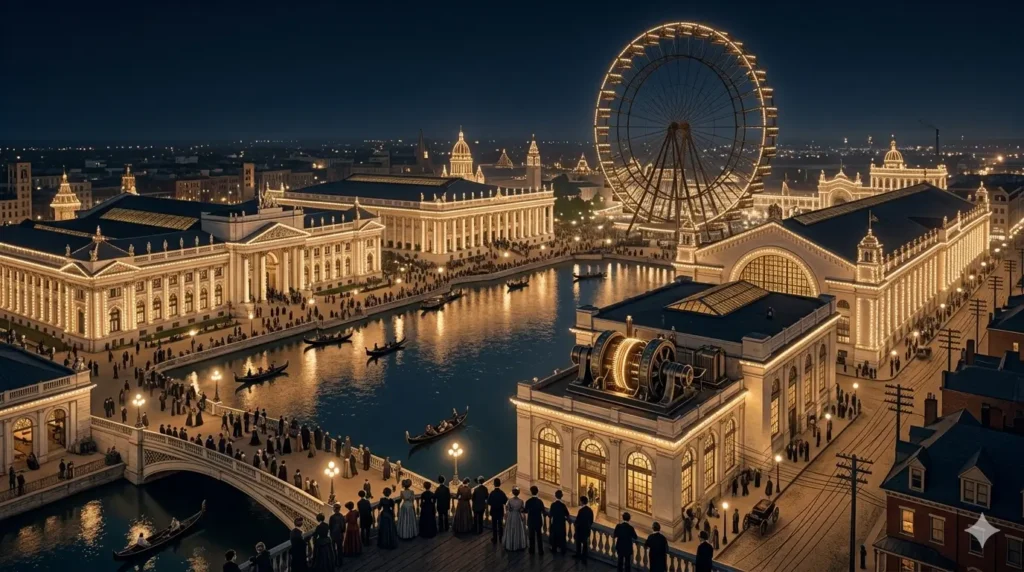
- The Chicago World’s Fair (1893): Westinghouse and Tesla won the contract to illuminate the fairgrounds by underbidding Edison. They lit up the entire exhibition using alternating current, creating the most magnificent display of electric light humanity had ever seen.
- The Niagara Falls Hydroelectric Power Plant: Built using Tesla’s designs, this historic power plant proved that alternating current could effortlessly power entire cities—first Buffalo, and later, New York City.
The war ended in a total victory for Tesla. Today, the entire world runs on alternating current.
Who Was the Real Genius and Who Was the Marketer?
There is no simple answer to this question, as both men left an monumental mark on humanity. However, their historical roles are sharply distinct:
Thomas Edison: The Business Magnate and Master Marketer
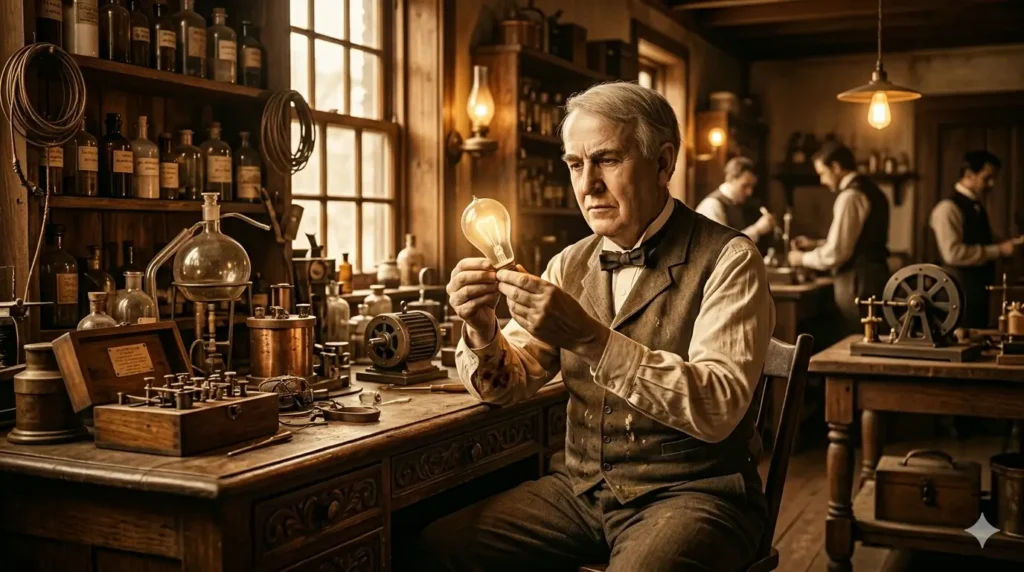
Edison was not much of a theoretical scientist; instead, he was a brilliant manager and a leader of inventing teams. He established the world’s first industrial research laboratory. He had an flawless instinct for what the market needed, how to package a product, and how to secure patents first. The light bulb, the phonograph, the motion picture camera—Edison knew exactly how to turn a great idea into millions of dollars.
Nikola Tesla: The Mad Genius and the Man from the Future
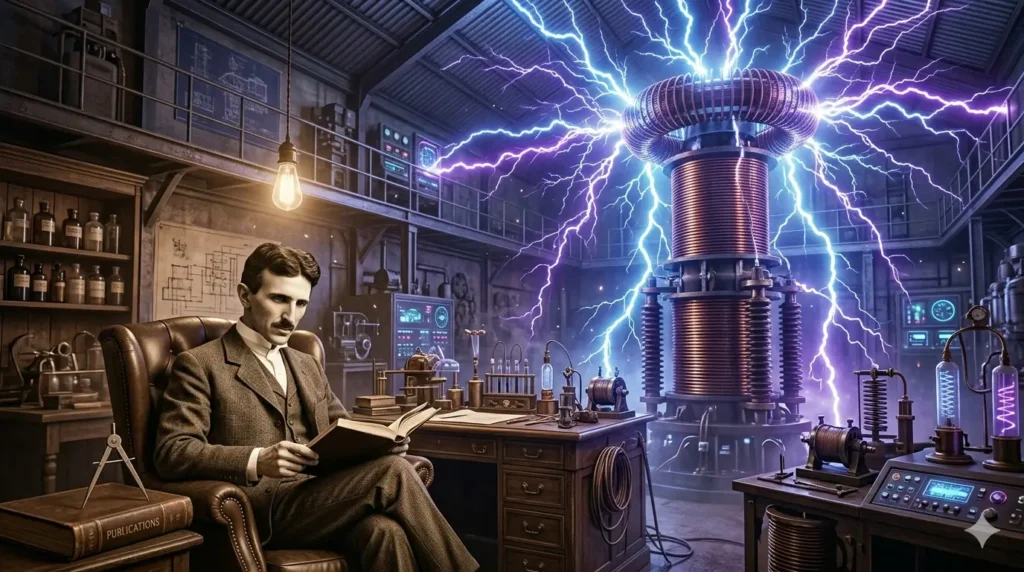
Tesla was a man living in the 19th century whose mind belonged to the 21st century. Beyond alternating current, he laid the foundations for radio, robotics, remote control, X-rays, and wireless energy transmission. However, he completely lacked business acumen. He famously tore up his lucrative contract with Westinghouse (which promised him royalties for every kilowatt generated) just to save his partner’s company from bankruptcy.
A Bitter Finale
Thomas Edison passed away as a wealthy, celebrated, and deeply influential American hero. On the other hand, Nikola Tesla, the man who wanted to gift the world free wireless energy, died in 1943 in a lonely New York hotel room, in absolute poverty.
Today, history has balanced the scales. Edison is rightfully respected as the father of modern business and industry, while Nikola Tesla has become the ultimate symbol of pure genius, self-sacrifice, and visionary thinking—a man whose ideas continue to power our modern world.
If you found the article interesting, share it with your friends and leave a comment.