
The forest where the trees dance.
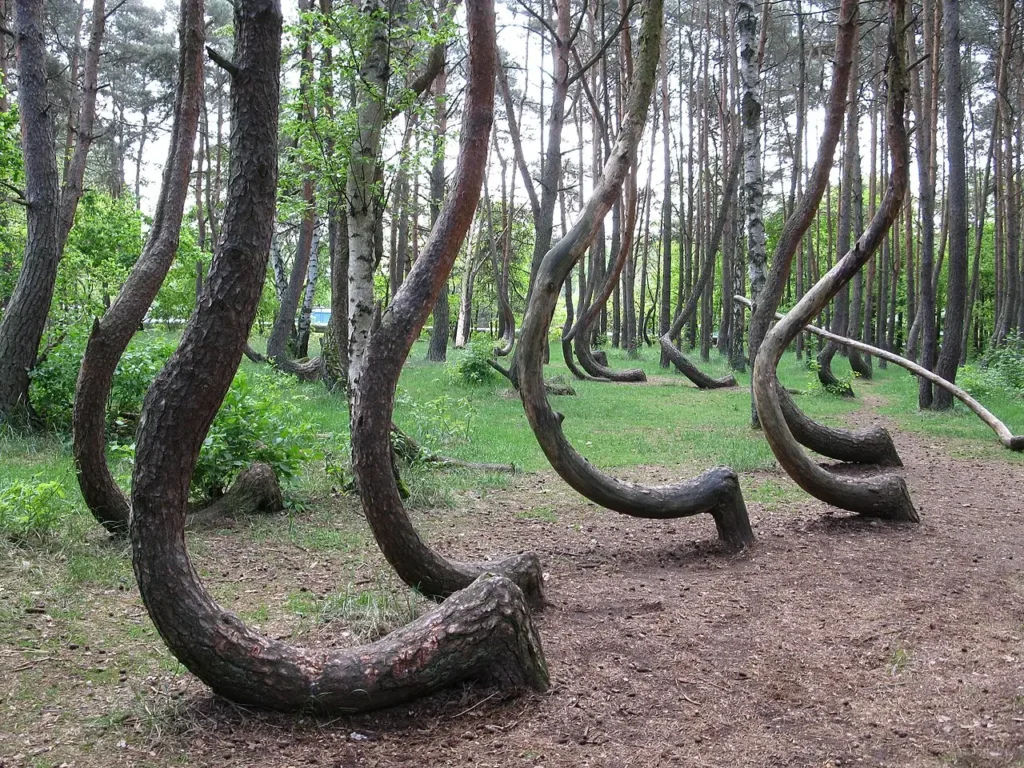
There are countless mysterious places on Earth, but some anomalies of nature so completely defy the laws of physics and biology that they leave even the most seasoned scientists utterly baffled. Imagine walking into a forest where not a single tree grows straight. Instead, hundreds of giant pines are strangely contorted at their very base, bent into identical curves as if frozen mid-dance.
This is not a scene from a fantasy movie — these are real places in Europe (Poland and the Kaliningrad region) that the world calls the “Crooked” or “Dancing Forests.” What force compelled these trees to grow this way, and why has modern science failed to find a definitive explanation for this phenomenon?
An Anomaly That Defies Belief
The most famous of these locations is situated in western Poland, near the town of Gryfino. Here, about 400 pine trees repeat the exact same bizarre shape: as they emerge from the ground, they bend sharply toward the north, forming a perfect 90-degree curve (a crescent shape), and only after 1 to 3 meters do they straighten out to grow skyward.
The most mystical part is that this “crazy” grove is surrounded by a perfectly normal forest where all the other trees grow absolutely straight. The anomaly is strictly confined to a specific perimeter. The trees themselves are healthy and, despite this severe deformation, have thrived for decades.

Theory 1: World War II Scars and Human Intervention
Since these trees were planted around the 1930s, the most popular scientific hypothesis points to human intervention. According to this theory, local carpenters or shipbuilders deliberately manipulated the young saplings. They might have placed heavy weights on them or bent them to the ground to naturally grow curved timber, which was highly valued for making furniture, sledges, or boat hulls.
Then World War II broke out. The area was evacuated, the locals abandoned their work, taking their secret with them to the grave, and the “trained” trees were left to grow on their own.
However, a question arises: Why would anyone spend so much energy individually manipulating 400 trees when thousands of straight trees stood around them? Furthermore, no traces of workshops specialized in using such curved wood have ever been found nearby.
Theory 2: Gravitational Anomaly and Earth’s Mysterious Magnetism
Proponents of more mystical theories believe that the Earth’s gravitational pull or magnetic field is disrupted in this particular location. Some scientists suggest that during the early stages of the saplings’ growth, a unique gravitational anomaly occurred, temporarily confusing the plants’ natural orientation instinct (geotropism) and directing them northward.
Local legends, however, state outright that the place is cursed, acting as an energetic portal where time and space operate differently. In fact, many tourists entering the forest complain of sudden anxiety and disorientation.
Theory 3: The Wrath of Nature — Heavy Snow or Storms?
Another popular hypothesis involves extreme weather events. It is possible that when the pines were still fragile saplings, the region was hit by an extraordinary snowstorm or a powerful cyclone.
A thick, heavy layer of snow could have pinned the young trees to the ground for an extended period. In the spring, when the snow melted, the tops of the trees began growing toward the sun again, but their bases and lower trunks remained permanently frozen in this bent position.
But critics reject this theory as well: if it was a natural disaster, why didn’t it damage the trees in the adjacent plots? Why did the heavy snow “choose” only these specific 400 trees to punish?
The “Living Curse” of the Baltic Coast
A similar phenomenon exists on the Curonian Spit (Kurshskaya Kosa), where the trees are twisted even more radically — into circles and spirals. A local legend tells of a Prussian princess who played the harp in the forest. The magic of her music breathed a soul into the trees, causing them to dance. When the music stopped, the trees froze forever in those dancing motions.
Modern biologists look for a more realistic cause here: the Curonian Spit region is frequently battered by strong, swirling sea winds, and the soil is unstable sand dunes. Additionally, there is a theory that the saplings were attacked at an early age by the larvae of a specific moth (Rhyacionia buoliana), which ate the central buds, causing the trunks to distort as they grew.

An Unsolved Mystery
Despite numerous expeditions, soil analyses, and tree-ring studies, there is still no single, 100% definitive answer that satisfies everyone.
Human hands, strange insects, the landing site of an alien spacecraft, or a magnetic anomaly? — The “Dancing Forests” continue to guard their secret, reminding humanity that nature still possesses mechanisms that our science cannot yet decode.
If you found the article interesting, share it with your friends and leave a comment.