
World’s First Temple-Göbekli Tepe
We are all familiar with the classic model of human development from school textbooks: humans first discovered agriculture, transitioned to a settled lifestyle, learned to make pottery, created the first villages, and only then, once the problem of food supply was solved, began to think about religion, monumental architecture, and grand temples.
This logical chain seemed unshakeable until archaeologists made a discovery in southeastern Turkey, in the Anatolia region, that shocked the global scientific community. This place is called Göbekli Tepe (meaning “Potbelly Hill”). It has pushed the dawn of human civilization back by a staggering 6,000 years.
An Unexpected Discovery
For decades, this hill was nothing more than ordinary agricultural land for local farmers. In fact, a superficial archaeological survey conducted in the 1960s dismissed the site, assuming it was just an abandoned cemetery from the Byzantine era.
Everything changed in 1994 when German archaeologist Klaus Schmidt, re-examining the area, noticed strange, fragmented pieces of carved limestone on the surface. He instantly felt that something grandiose was hidden beneath the hill. The excavations that began the following year opened a brand-new chapter in the history of world archaeology.
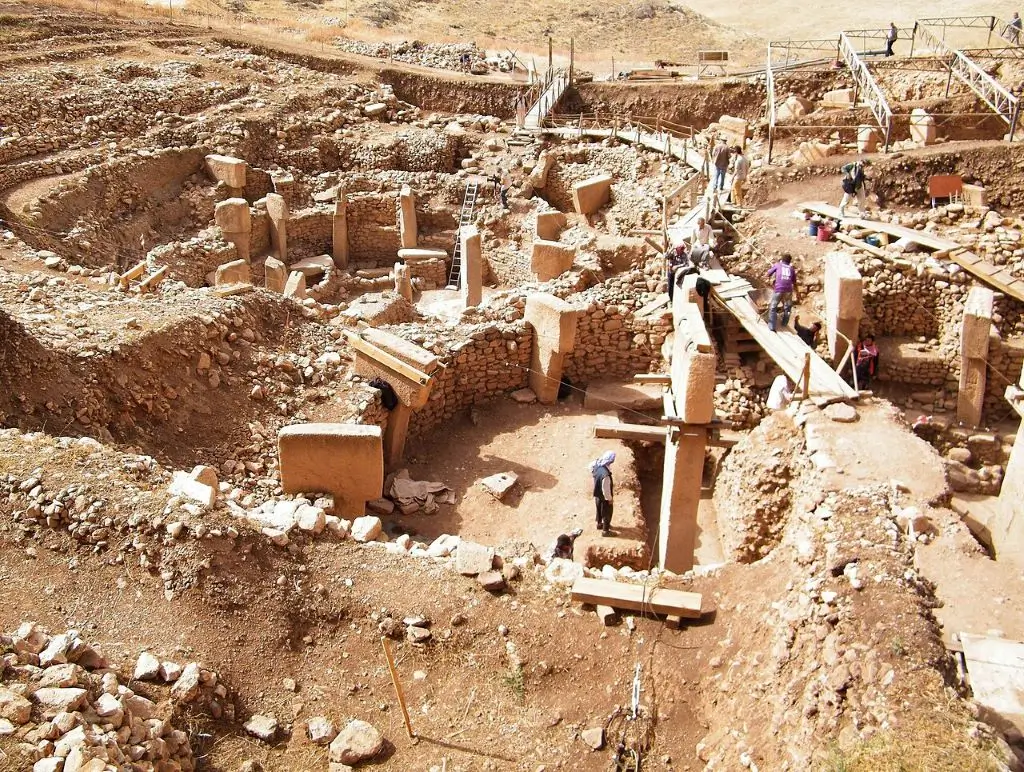
Radiocarbon dating revealed that the complex was built around 10,000–9,600 BC. For comparison:
- It is 6,000 years older than Stonehenge.
- It predates the first Egyptian pyramids by 7,000 years.
- The complex was built when the Ice Age was just ending on Earth, and humans did not yet possess metal tools, agriculture, domesticated animals, or even pottery.
Stone Giants and Mysterious Symbols
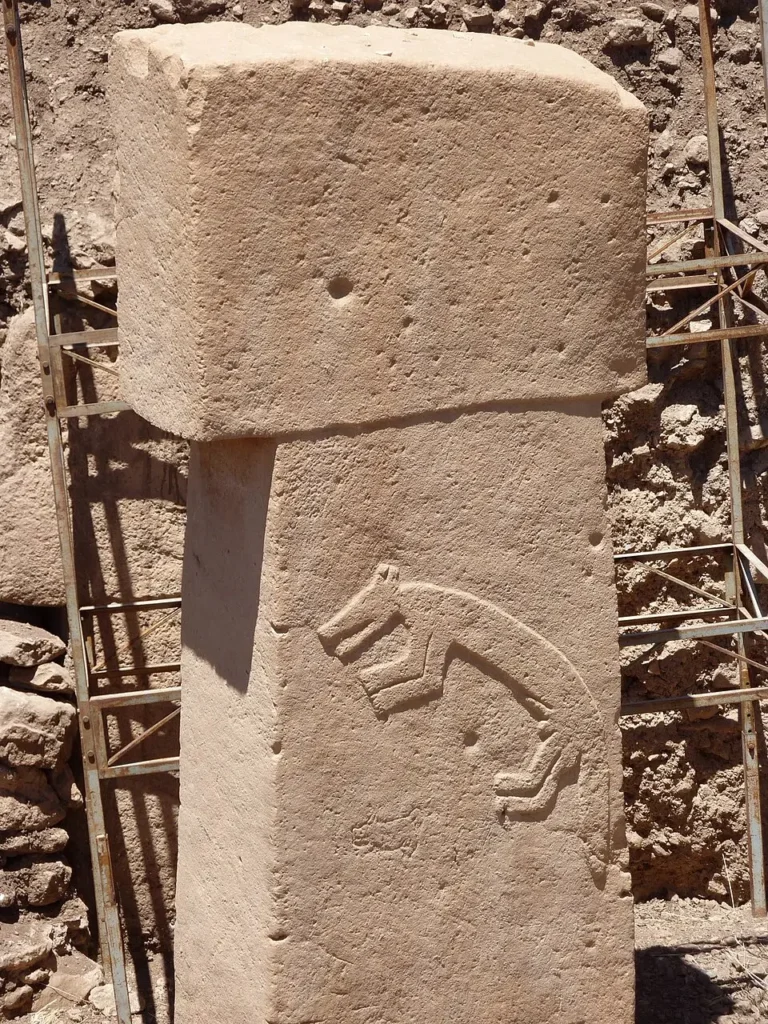
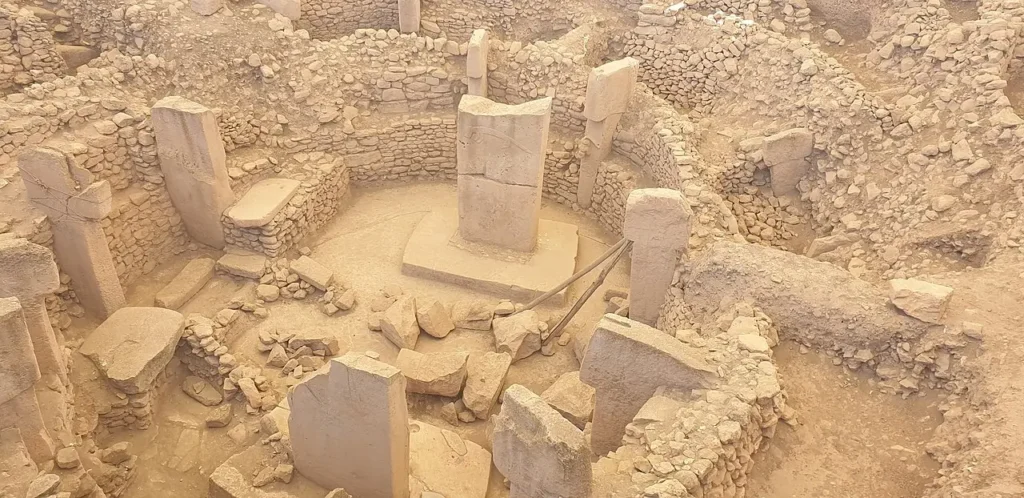
Göbekli Tepe is not just a single building. It is a massive complex consisting of several circular structures. At the center of each circle stand two gigantic, T-shaped limestone pillars that reach up to 5.5 meters in height and weigh between 10 and 20 tons. Surrounding these central pillars are smaller walls and additional pillars.
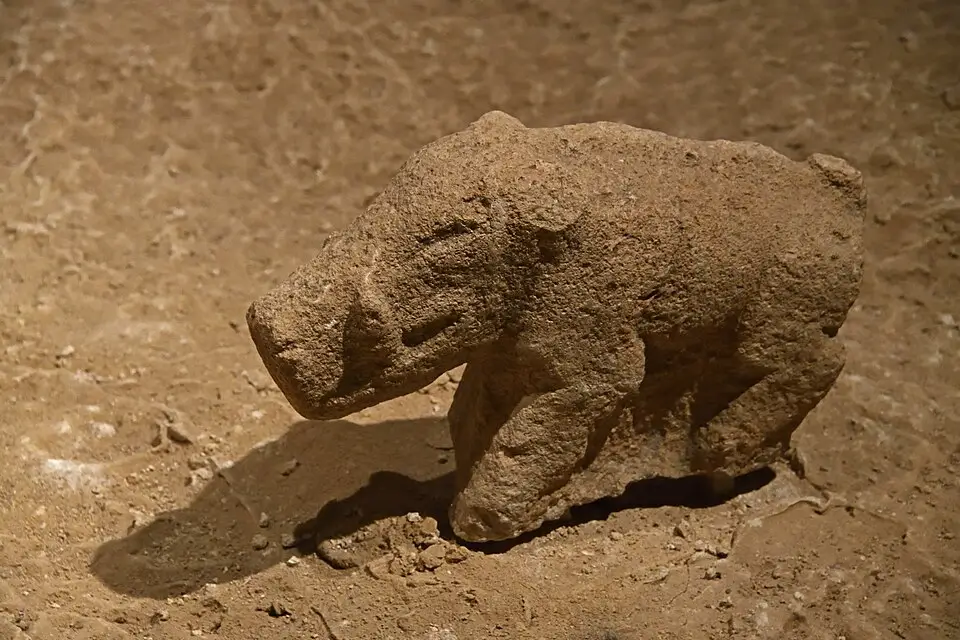
The most astonishing part is that these monoliths are not plain. They are carved with incredible craftsmanship, featuring relief images of various animals, birds, and insects:
- Fierce lions and leopards,
- Wild boars and foxes,
- Snakes, scorpions, and spiders,
- Cranes, vultures, and ducks.
Archaeologists believe these T-shaped pillars represent stylized human figures. On some of them, arms draped down the sides and belts fastened around the waist are clearly visible. However, they have no faces. Who were these faceless giants? Gods? Ancestral spirits? Or beings from another world?


The Main Paradox: Who Built the Complex?
The core mystery of Göbekli Tepe lies in its engineering. Quarrying tons of heavy stone, transporting them over several kilometers, and erecting them vertically would have required the coordinated labor of hundreds of people.
And here we encounter the ultimate contradiction: during that era, humans lived in small, nomadic groups of 20–30 people (hunter-gatherers). They had no kings, no state structures, or bureaucracies capable of organizing such a massive workforce. Furthermore, no traces of permanent housing, hearths, or water systems have been found in the immediate vicinity. This means people did not live here—they only traveled from afar for a very specific purpose.
A New Formula for History: Klaus Schmidt proposed a revolutionary theory that flipped science on its head: “The temple came before the city.” It wasn’t agriculture that gave rise to religion; rather, it was the religious need—the desire to gather at this grand sanctuary—that forced humans to invent a permanent food source (farming wheat) to feed the massive workforce. Interestingly, genetic research has shown that the homeland of modern cultivated wheat is the mountains located right near Göbekli Tepe.
A Deliberately Buried Secret
While building the complex was a monumental feat, its end is even more mysterious and inexplicable. Around 8,000 BC, after roughly 1,500 years of active use, humans stopped using Göbekli Tepe.
However, they didn’t just abandon or destroy it—they deliberately buried it underground. Hundreds of tons of soil, stone, and debris were purposefully brought in to completely cover this grand complex beneath an artificial hill.
Why did they do this? What were they trying to hide? Or was it a “time capsule” meant for future generations? Thanks to this incredible preservation, Göbekli Tepe reached us almost untouched and undamaged.
What is the Status of the Research Today?
Today, only 5% to 10% of the Göbekli Tepe site has been excavated and studied. Ground-penetrating radar scans show that at least 15–20 identical circular complexes and hundreds of pillars are still buried underground, waiting their turn.
New discoveries are made here every year. Scientists still debate whether this place was an astronomical observatory (where the pillars mirrored the alignment of the stars), a sanctuary for a cult of the dead, or the first collective “peace center” in human history, where different tribes forgot their enmities.
One thing is certain: Göbekli Tepe proved that our distant ancestors were far smarter, more organized, and spiritually evolved than we ever imagined. This “Potbelly Hill” continues to remain silent, guarding a secret that may take decades to fully unlock.
If you found the article interesting, share it with your friends and leave a comment.