What Happens in the Human Brain When We Pray? — Science Has an Answer
Human beings have been praying for thousands of years. For some, prayer is a conversation with God; for others, it is an expression of gratitude, a way of overcoming fear, asking for help, or seeking inner peace. But there is a question that science has increasingly focused on in recent decades: what happens inside the human brain during prayer?

Modern neuroscience can now observe changes in brain activity during prayer, meditation, religious rituals, and other spiritual practices. Researchers use functional magnetic resonance imaging (fMRI), electroencephalography (EEG), PET scans, and other techniques to observe which brain regions and networks become more or less active. A systematic review published in 2026, which examined 105 studies conducted between 1998 and 2026, found that religious and spiritual practices are indeed associated with measurable changes in brain activity. At the same time, researchers emphasize that different practices are not identical and cannot be reduced to one simple formula.
But this raises an even more fascinating question: if science can observe what happens in the brain during prayer, can it also tell us what prayer itself means? This is where neuroscience meets the boundaries of religious experience.
Prayer Is Not Simply the Repetition of Words
When a person prays silently or aloud, it may appear from the outside that they are simply repeating words. In reality, numerous processes are taking place in the brain at the same time. A person has to remember words, maintain attention, form thoughts, direct them toward a particular recipient, and regulate their emotional state.
Personal prayer is especially interesting when a person addresses God as a being or person. Studies suggest that during such prayer, activity can occur in neural networks involved in social cognition — the ability to think about other people’s intentions, emotions, and mental states.
A 2026 systematic review of studies on religious and spiritual practices found that personal prayer can involve brain regions associated with social interaction and with representing the mind of another being.
This does not mean that science has proved direct communication with God. Neuroscience can observe how a person’s brain responds to an experience that the person understands as communication with God. It cannot determine through brain imaging whether a supernatural being exists behind that experience.
That distinction is extremely important.
How Does the Brain Process Thinking About God?
The human brain has the ability to imagine another person’s thoughts, intentions, and emotions. In psychology, this ability is often discussed in terms of the theory of mind. When someone says, “God knows what I am thinking,” or tells God about their problems during prayer, they are not merely producing words — they are constructing a model of a relationship in their mind.
Research has shown that religious prayer can involve neural networks associated with theory of mind, including regions such as the medial prefrontal cortex and the temporoparietal junction.
From a neuroscience perspective, prayer is therefore a fascinating phenomenon: the human brain can operate as though it is engaged in a relationship with a perceived other being, even though science itself cannot determine the supernatural nature of that relationship.
This may help explain why many people describe prayer as a “conversation” rather than simply repeating a text.
What Happens When a Person Prays Repeatedly?
Repetition is an important element of ritual prayer. Repeating the same words, texts, or movements can direct attention within a particular framework.
Similar mechanisms have also been investigated in meditation and repetitive recitation. A 2016 meta-analysis examining 78 functional neuroimaging studies of meditation found that different types of meditation affect different brain regions and networks in different ways.
This means that a statement such as “meditation activates one particular part of the brain” would be an oversimplification.
The same principle applies to prayer. Not all prayer is the same.
A short personal prayer, a religious text recited aloud, group prayer, rhythmic chanting, and a long meditative prayer may involve different patterns of brain activity.
Prayer and Emotions
Another important aspect of prayer is emotion.
People often pray when they experience fear, grief, gratitude, loss, or hope. In such situations, prayer is no longer merely a verbal activity. It becomes an emotional experience.
Modern research suggests that religious and spiritual practices are associated with neural systems involved in attention control, emotional regulation, self-perception, and reward processing. A 2026 systematic review reported repeated involvement of regions including the prefrontal cortex, anterior cingulate cortex, insula, amygdala, hippocampus, and the so-called default mode network.
But caution is necessary here as well. A change in activity in a particular brain region does not automatically reveal exactly what a person is experiencing. The same brain region can participate in several different psychological processes.
Can Prayer Affect the Body as Well?
Scientists studying prayer do not focus only on the brain. Some studies also examine heart rate, blood pressure, breathing rate, and other physiological measures.
A 2021 systematic review examined studies investigating the direct physiological effects of prayer. The authors identified only eight relevant experimental studies, which shows that the evidence base is still relatively small. Most of these studies found measurable changes during prayer, including changes in some neurocognitive and physiological measures, although the results varied between studies.
This is an important reminder: research exists, but there is not yet enough evidence to say that prayer produces exactly the same physiological effects in everyone.
An Interesting Experiment on Prayer and Stress
One study examined Islamic prayer, or salah, and measured biological markers in participants’ saliva. The study included 83 healthy people. Researchers measured cortisol and alpha-amylase levels before and after prayer.
The results were interesting: changes in cortisol depended on the participants’ initial cortisol levels. In some groups, cortisol decreased, while in others it increased. The researchers also observed changes in other biological indicators. However, the authors noted that further studies are needed to confirm the findings.
This example is particularly important because it shows that one study does not provide a final scientific answer.
Can Prayer Reduce Stress?
The most careful answer is: prayer may help some people manage stress, but science cannot say that prayer is a universal method of reducing stress for everyone.
There are several possible explanations.
When a person prays, they may temporarily step away from everyday problems. Their attention shifts toward one specific activity, they repeat certain words, or they simply sit quietly and organize their thoughts.
Attention regulation, changes in breathing, emotional processing, and a sense of social or spiritual support may all contribute to the experience.
However, these mechanisms are not exclusive to religious prayer. Similar neural processes can also be involved in meditation, concentration, and other repetitive practices. Modern neuroscience reviews of meditation emphasize that results are difficult to interpret in a simple way and that different practices can produce different effects.
Prayer and the “Wandering Mind”
The human brain often finds it difficult to remain focused on one thing for a long period. In everyday life, we may simultaneously think about the past, the future, our problems, and other people.
Neuroscience uses the term default mode network (DMN) for a network associated with self-referential thinking, memories, and mind-wandering.
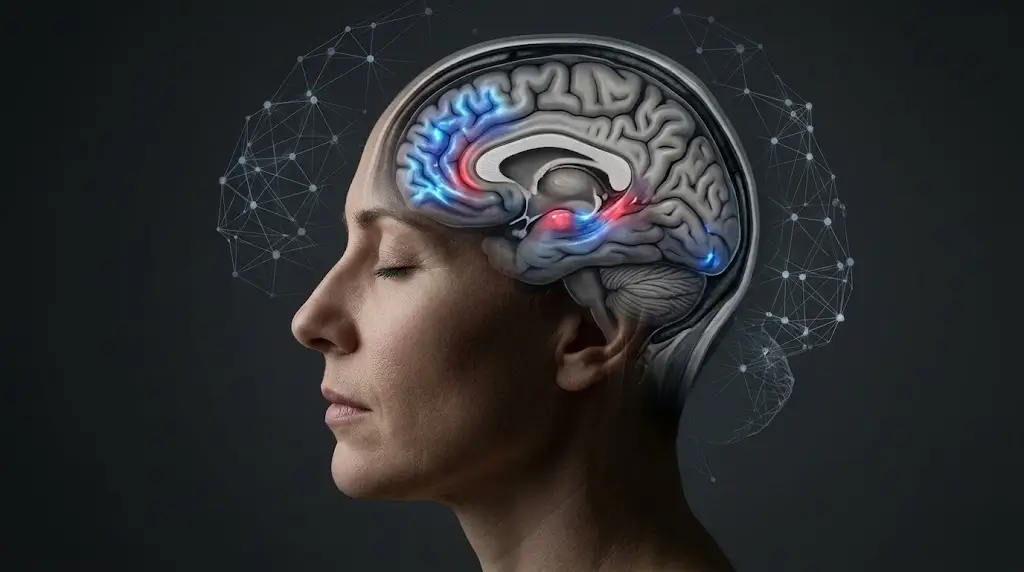
Changes in the activity of this network have been studied extensively in meditation research. According to a 2026 systematic review, modulation of the default mode network was one of the recurring findings across different spiritual practices, although the effect depended on the type of practice and the experimental conditions.
During prolonged prayer, repeatedly bringing attention back to a particular object may therefore influence processes associated with inner dialogue and attention control.
But this does not mean that the brain is “switched off” during prayer. On the contrary — the brain remains highly active, but the organization of its activity may change.
Can Prayer Produce Long-Term Changes in the Brain?
This is an even more fascinating question.
The brain has a capacity known as neuroplasticity — its structure and functional connections can change as a result of experience and practice. Learning, musical training, physical exercise, and many other long-term experiences can leave measurable traces in the brain.
Researchers have also begun examining this question in relation to religious and spiritual practices. A 2026 systematic review summarized studies reporting structural differences in people with long-term spiritual or religious practices.
However, interpreting such findings is particularly difficult. Researchers cannot always determine with certainty whether a particular difference was caused by prayer or meditation itself. Age, lifestyle, personality, and many other factors may also play a role.
That is why longer-term, controlled studies are necessary.
The Most Interesting Question: Has Science “Found God” in the Brain?
No.
And this may be the most important part of the entire subject.
If scientists observe changes in a particular brain region while a person is praying, this does not prove or disprove the existence of God.
A brain scanner shows how the human brain functions during a particular experience. It cannot tell us whether the source of that experience is purely psychological, an expression of religious belief, a divine relationship, or something that modern science does not yet know how to measure.
These are two different questions.
Science asks: “What happens in the human brain?”
Religion may ask an entirely different question: “Who or what is this experience connected to?”
Confusing these questions can easily lead to incorrect conclusions.
Why Do Some People Feel That They Are No Longer Alone During Prayer?
This is perhaps one of the most fascinating aspects of the subject.
Across different religious traditions, people have described feelings of peace, closeness, comfort, or the presence of God during prayer for centuries.
Neuroscience can investigate some of the psychological and neural correlates of these experiences. But the subjective meaning of an experience cannot be determined simply by looking at a brain scan.
For a person who believes in God, the feeling of closeness during prayer may be experienced as a genuine spiritual relationship. Another researcher may describe the same experience in terms of neural and psychological processes.
A brain scan alone cannot provide a final answer between these interpretations.
Prayer and Meditation Are Not the Same Thing
Prayer and meditation are often placed in the same category, but this is not always accurate.
There are many forms of meditation, with different purposes. Some focus on breathing, others on a mantra, and others on open awareness or developing compassion. Research shows that these different practices can produce different patterns of brain activity.
Prayer also takes many forms: personal prayer, reading religious texts, repetitive prayer, chanting, group prayer, silent prayer, and others.
Therefore, the statement “science has proved that prayer changes the brain in this particular way” is an oversimplification.
A more accurate statement would be: research shows that prayer and other religious practices are associated with measurable brain and bodily processes, but their mechanisms differ and the field is still developing.
What Can Science Not Tell Us?
This may be the most important section of all.
Science can measure:
- changes in brain activity;
- certain blood or saliva biomarkers;
- changes in heart rate and breathing;
- some processes related to attention;
- certain physiological aspects of emotional responses;
- possible long-term neuroplastic changes associated with sustained practice.
But from these measurements alone, science cannot directly determine:
- whether God exists;
- whether God heard a particular prayer;
- whether a specific miracle occurred;
- whether a particular religious experience has a supernatural origin.
These questions belong to a different category.
One of the strengths of science is precisely that it tries not to claim more than the evidence allows.
So, What Has Changed in Our Understanding?
Several decades ago, the neuroscience of religious experience was far less developed. Today, researchers can study various aspects of brain activity during prayer and other spiritual practices.

A broad systematic review published in 2026, combining 105 studies, found that different religious and spiritual practices are associated with neural systems involved in attention, emotional regulation, self-perception, and social cognition. At the same time, the authors emphasized the substantial differences between studies and the many unanswered questions that remain.
So today we can say one thing with reasonable confidence:
When a person prays, their brain is certainly not in a passive state.
Attention, memory, emotion, social cognition, and self-reflection can all be involved. Long-term religious practice may also be associated with lasting changes in brain function and structure, although stronger research is needed to establish cause-and-effect relationships.
But the greatest mystery remains.
A brain scanner may show us what happens inside a person’s brain when they speak to God.
But it cannot answer the question that humanity has asked for thousands of years:
When a person prays, are they speaking only to themselves — or is there truly someone on the other side of that conversation?
Neuroscience has no final answer to that question today.
And perhaps that is precisely what makes prayer one of the most fascinating subjects at the boundary between the human brain, science, faith, and the questions humanity has been asking for thousands of years.
Sources
The scientific basis of this article includes systematic reviews and research in neuroscience, including a 2026 systematic review of 105 studies, a systematic analysis of the physiological effects of prayer, and a meta-analysis of functional neuroimaging studies of meditation.
2026 Systematic Review — The Neuroscience of Religious and Spiritual Practices
Systematic analysis of the physiological effects of prayer
A meta-analysis of 78 neuroimaging studies on meditation
If you found the article interesting, share it with your friends and leave a comment.