
The Invisible Backbone of the Internet
The Internet is one of the most important arteries of the modern world. Our communication, education, financial system, media, and everyday activities depend on it. At first glance an invisible network, in reality, it unites people, countries, and economies into one common digital space.
When we think about the Internet, we often imagine an abstract “cloud,” wireless signals, and an invisible digital space. In reality, however, the Internet is very tangible and “earthly” — it functions through cables stretched under the ground, in buildings, and especially on the ocean floor. The backbone of modern global communication is precisely this less visible infrastructure.
Where Does the Internet Actually Run?
Despite a widespread myth, the majority of international internet traffic is not transmitted via satellites. Satellites are slow, expensive, and limited for large volumes of data. Instead:
- About 95–99% of global internet traffic passes through fiber-optic cables
- These cables connect continents with each other
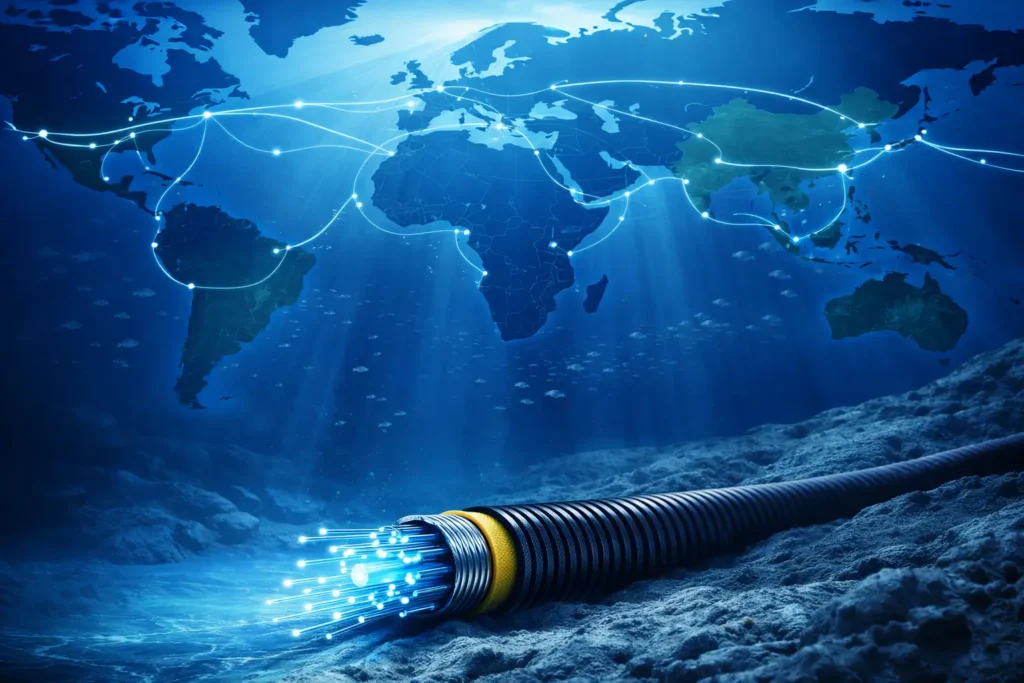
- They run along the floors of the Atlantic, Pacific, and Indian Oceans, as well as the Mediterranean Sea
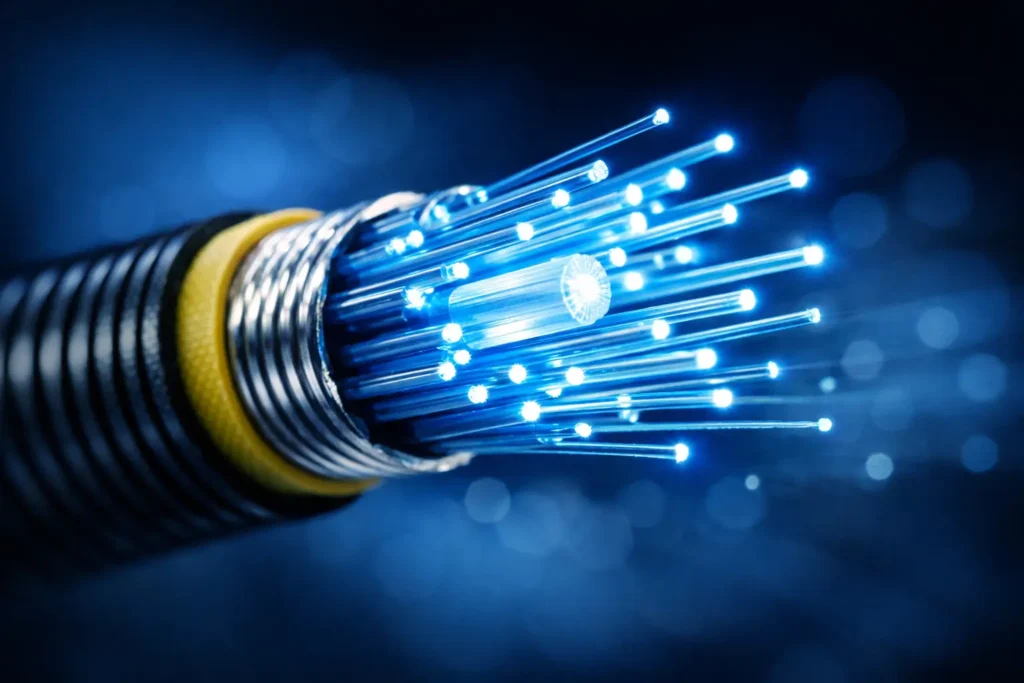
A macro image of a fiber-optic cable stretched along the ocean floor with glass fiber inside, where light pulses travel, illuminated background, stylized.
Structure of a fiber-optic cable
Today, more than one million kilometers of optical cables are stretched across the ocean floors — enough to circle the Earth multiple times.
People may think these cables are giant, heavy pipes, but in reality, in the deep ocean, a cable is often as thick as a garden hose, and inside it runs a glass fiber as thin as a human hair. Data travels through this fiber in the form of light pulses. In fact, your message, video, or banking transaction is a flicker of light traveling thousands of kilometers under complete darkness.
Near coastlines, cables are thicker — protected with additional armor, because this is where the risk of damage is highest.
What Threatens the Internet on the Ocean Floor?
In popular culture, we often hear stories about sharks biting cables. In reality, the problems are much more “human.”
Statistically:
- About 70% of cable damage is the result of human activity
- The main causes are:
- fishing nets
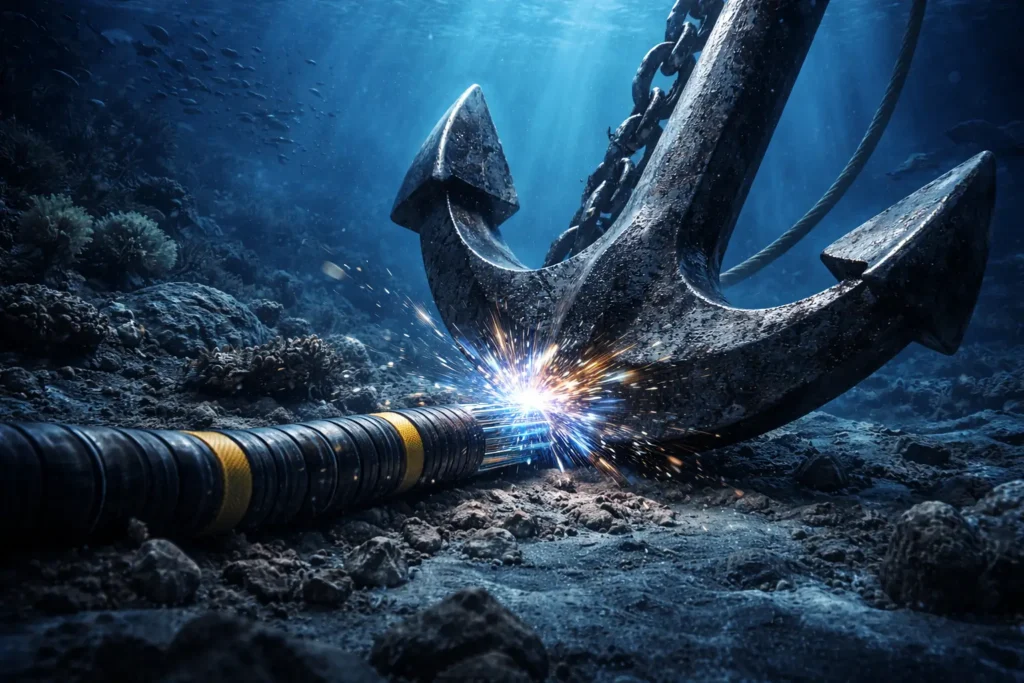
- ship anchors
- oil and gas platforms
Sharks did indeed damage cables in the past, as electromagnetic fields attracted them, but modern technological advances have practically eliminated this problem.
A vivid digital illustration: a heavy ship anchor damages an optical cable in the ocean, parts of the cable glow, underwater scene with glass fiber.
Damage to an optical cable by a ship anchor
The Internet on the Ocean Floor — In a Desolate Space
Cables lie on the ocean floor for years:
- in complete darkness
- under enormous pressure
- practically without daily control
There are no cameras or constant monitoring on them. Damage is often detected when:
- internet speed drops
- connection is interrupted
- traffic suddenly reroutes through another path
Interestingly, the user may not notice the problem at all — the Internet automatically tries to use alternative routes, but in network control centers, an emergency mode is already in effect.
An infographic shows internet cables stretched along the ocean floor connecting continents, colorful routes, lighting style.
Optical cable on the ocean floor
How Is a Damaged Cable Repaired on the Ocean Floor?
Although it involves high technologies, the repair process partly resembles methods from the 19th century.
The process looks like this:
- A specialized ship determines the exact location of the damage
- An underwater robot or crane lifts the cable from the seabed
- Technicians manually connect the optical fibers under a microscope
- The cable is lowered back to the ocean floor
Sometimes repairs are completed in a few days, and sometimes they last for months — everything depends on the weather, depth, and location of the damage.
A cable repair ship at sea, workers on the ship in the process of work, lifting an optical cable from the seabed, stylized image.
Cable repair ship in operation

Geopolitics on the Ocean Floor
Ocean cables are not only technological objects — they are infrastructure of strategic importance.
They support:
- banking systems
- stock exchanges
- military and state communication
- media and social networks
Some countries know exactly:
- where their “weak points” are located
- which cable damage will cause large-scale problems
Therefore, some routes are not even fully published publicly. In recent years, cables on the ocean floor have increasingly become a subject of international political tension.
Conclusion
The Internet, which has become an integral part of everyday life in modern society and is often perceived as an abstract, “invisible” system, in reality is based on clearly defined physical infrastructure. Its continuous functioning depends on fiber-optic cables located on the ocean floor, extremely thin strands of glass, as well as the interaction of human factors and natural environmental conditions.
This infrastructure is characterized simultaneously by fragility and strategic importance. Despite its vulnerability, it is precisely this system that ensures global communication, economic processes, and the free flow of information. Accordingly, the Internet should be considered not only as a digital space, but as a physically existing, global technological system that essentially “lives” in the depths of our planet’s waters and represents one of the fundamental pillars of the functioning of modern civilization.
If you found the article interesting, share it with your friends and leave a comment.