
Hypatia — The Most Famous Female Scientist of the Ancient World
In the second half of the 4th century AD, in the magnificent Egyptian city of Alexandria, a woman was born whose name would not be forgotten by humanity even more than 1,600 years later. Much of her life has been lost to history, most of her works have not survived, and we do not even have an accurate description of what she looked like. Yet what has survived is enough for us to consider Hypatia one of the most remarkable intellectuals of the ancient world. She was a mathematician, astronomer, philosopher, and teacher — a woman who earned authority in an era when higher education and scientific activity were considered almost entirely a male domain.

Hypatia’s story is not simply the biography of a scientist. Her life tells us about a world where ancient Greek philosophy, Roman political power, and the growing Christian culture were intricately intertwined. She lived in Alexandria, a city that for centuries had been one of the most important intellectual centers of the Mediterranean world. Different cultures, religions, and traditions of knowledge came together there. But this diversity did not always mean peaceful coexistence. During the final years of Hypatia’s life, tensions in the city became particularly intense, and she ultimately became one of the most tragic victims of that conflict.
Alexandria — A City Where Knowledge Coexisted with Power

To understand Hypatia’s story, we must first imagine Alexandria itself. The city was founded by Alexander the Great in 331 BC and, over the following centuries, became one of the largest cities of the Mediterranean world. Merchants, philosophers, physicians, mathematicians, astronomers, and representatives of many different cultures gathered there. Alexandria was famous for its Museum and Library, although, contrary to popular belief, the city’s intellectual life did not depend on a single library, and its scientific tradition continued for centuries.
Hypatia lived during the later period of this long intellectual tradition. By her time, Alexandria was already very different from the city of the Ptolemaic era, when Euclid, Eratosthenes, and other famous scholars had worked. Christianity was rapidly gaining strength in the Roman city, but ancient Greek philosophical and scientific traditions were still alive. It was in this transitional era that Hypatia grew up and became one of the most educated people in her city.
The Daughter of Theon

Hypatia’s father was Theon of Alexandria, a mathematician and astronomer whose name is particularly associated with his work on the writings of Euclid and Ptolemy. Theon worked on commenting on complex mathematical and astronomical texts and sought to make their knowledge more understandable and useful for future generations. It was in this intellectual environment that Hypatia grew up.
We do not have detailed information about her education, but the sources show that she took the knowledge she received from her father much further. Hypatia was not merely a well-educated daughter — she herself became an authoritative teacher and thinker. Her work included mathematics, astronomy, and philosophy, and by around 400 she was regarded as one of the most prominent intellectuals in Alexandria.
This was particularly significant for her era. Women in the ancient world did have opportunities to receive education, but a woman publicly teaching and having influential men among her students was still extremely rare. Hypatia managed to establish her own authority in precisely such an environment.
The Woman Men Listened To
One of the most fascinating details about Hypatia concerns her students. She taught philosophy and science, and her audience was not limited to young students. An educated circle gathered around her, some of whose members later held important political and religious positions.
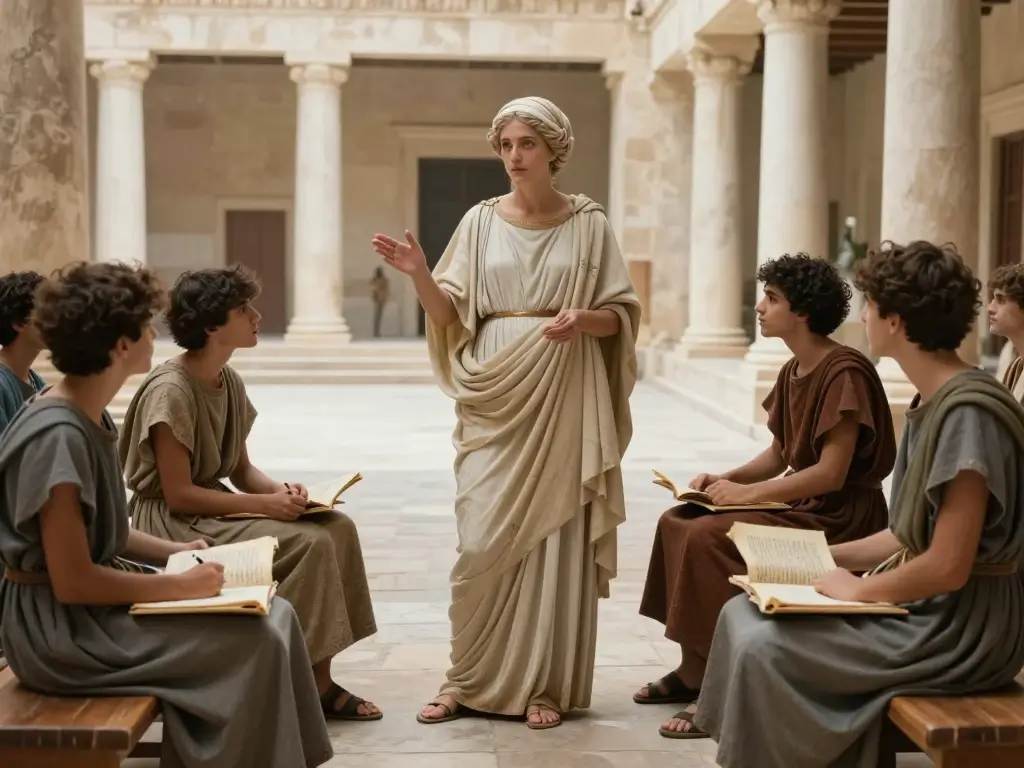
Among them was Synesius of Cyrene, who later became a Christian bishop. Synesius’s surviving letters are among the most important primary sources concerning Hypatia. His letters show that he held Hypatia in great respect and regarded her not merely as a teacher but also as an intellectual authority. This is particularly interesting because it shows that Hypatia’s social environment was much more complex than it is often portrayed in modern popular histories.
Hypatia did not live in a world where every Christian regarded her as an enemy and every scientist stood on her side. In reality, her students and associates held different religious and philosophical views. For this reason, reducing her story to a simple conflict of “science versus Christianity” does not fully reflect the historical reality.
What Did Hypatia Teach?
Our knowledge of Hypatia’s scientific work is incomplete. None of her major works has survived in full, so we often learn about her ideas from references by other authors. She is associated with commentaries on Diophantus’s Arithmetica and Apollonius of Perga’s Conics, as well as work connected with Ptolemy’s astronomical writings. The exact extent of this work remains a subject of scholarly debate, but it is clear that Hypatia was seriously involved in the mathematical and astronomical knowledge of her time.
Her importance should not be sought only in the creation of new theories. In the ancient world, preserving, editing, commenting on, and teaching complex scientific texts was itself an enormous intellectual undertaking. Knowledge was transmitted through manuscripts, and as texts passed from one generation to another, they could become distorted or disappear entirely. Scholars who worked on these texts and taught them to others played an important role in preserving knowledge.
Hypatia was one of the outstanding representatives of this tradition. She was neither merely a theoretical philosopher nor simply a mathematics teacher. Her work combined several disciplines, an approach characteristic of ancient education.
Studying the Stars
Astronomy is particularly closely associated with Hypatia. For scientists of her era, studying the heavens meant far more than simply observing the stars. It required complex mathematical calculations, geometric models, and special instruments used to study the movements of celestial bodies.
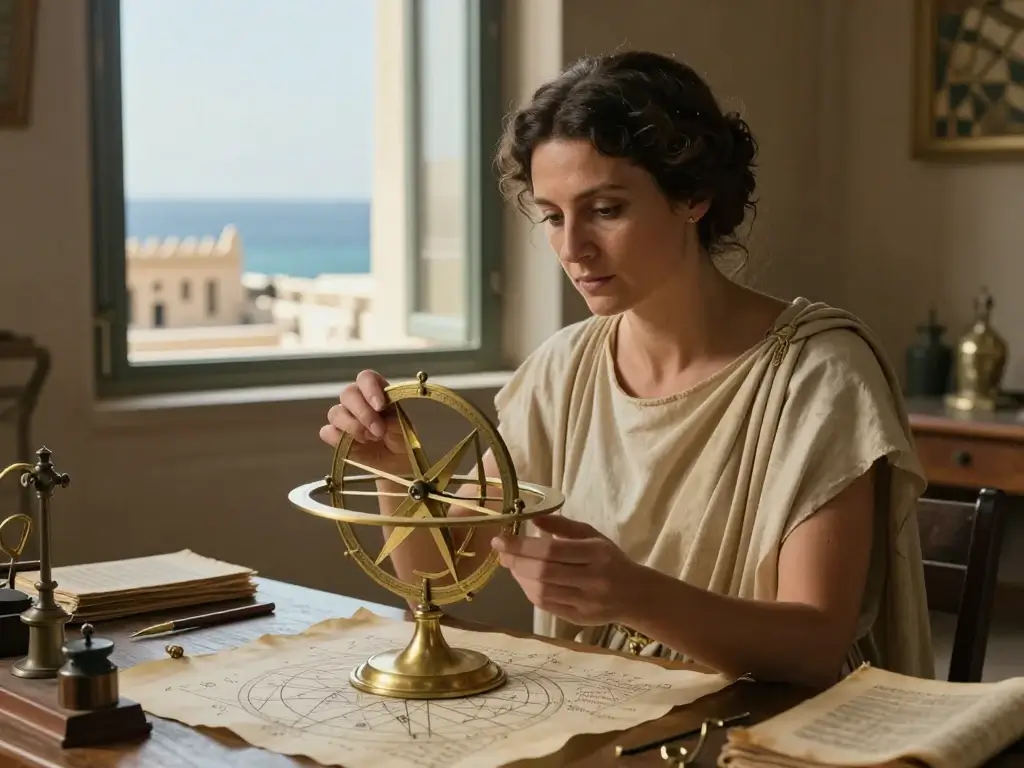
One such device was the astrolabe. This sophisticated instrument was used for various astronomical calculations and required a considerable level of knowledge to operate. Letters written by Hypatia’s student Synesius indicate that she possessed knowledge related to the astrolabe, and Synesius even consulted her about matters concerning the construction of such an instrument.
This detail is especially important. It shows that Hypatia was not simply an intellectual engaged in philosophical discussions. She was also connected to the practical scientific knowledge that was extremely important in her world.
The Philosopher Who Sought to Explain the Universe Through Reason
Hypatia belonged to the Neoplatonic tradition. Neoplatonism sought to understand the nature of the universe, the human mind, and the foundations of existence. Mathematics also held a special place in this philosophical school, because numbers and mathematical order were regarded as expressions of the rational structure of the universe.
Hypatia taught within this intellectual environment, and her school became one of the important philosophical centers of Alexandria. We do not have detailed records of her teaching, but her influence on her students is clear. They remembered her with great respect and did not regard her knowledge as merely information acquired in particular subjects.
This part of her life is particularly interesting to modern readers because it shows that science and philosophy were not as strictly separated in that era as they are today. Mathematics, astronomy, and philosophy often formed parts of a single intellectual world.
A City Where Tensions Were Growing
The final years of Hypatia’s life coincided with a period of political and religious tension in Alexandria. In 412, Cyril became bishop of Alexandria, and serious disagreements soon arose between him and the city’s Roman prefect, Orestes. These were not merely theological disputes — they also involved influence within the city, the authority of government, and the struggle for power between different groups.
Hypatia was not a direct political participant in this conflict, but she possessed considerable social authority and had a close relationship with Orestes. This circumstance connected her name to the political conflict. Her opponents may have believed that she was preventing an agreement between Orestes and Cyril, although her actual role in the dispute is not known with certainty.
This is the point at which Hypatia’s story becomes particularly complicated. We know that conflict existed in the city, and we know that Hypatia was an influential figure during this period of tension, but it is impossible to reconstruct every detail of her murder with certainty.
415 — The Tragic End of Hypatia
Around 415, Hypatia was brutally murdered in Alexandria. According to the early Christian historian Socrates Scholasticus, a mob attacked her in the street. The attackers dragged Hypatia from her carriage, took her to a church, and killed her. Her body was then carried outside the city and burned.

It was one of the most horrifying murders in the history of Alexandria at the time. But the motive behind the murder still requires careful consideration. According to the popular version, Hypatia was killed because she was a pagan female scientist whom the Christian authorities disliked. Historical sources, however, present a more complicated picture.
Hypatia was indeed associated with the pagan philosophical tradition, and her murder took place against a background of religious tension. But the political circumstances of her death are also clear. She was connected to Orestes, while the conflict between Orestes and Cyril was intense. For this reason, modern historians do not interpret her death simply as a battle between “religion and science.”
There is no evidence proving that Cyril directly ordered her murder, although suspicions concerning people connected with his supporters appear in historical sources. For this reason, caution is necessary: we can say with confidence that Hypatia became a victim of mob violence during a period of political and religious conflict, but we do not have an unequivocal answer concerning every detail of her murder.
Was Hypatia Killed Because of Science?
This question appears in almost every modern account of Hypatia. The answer is more complicated than a simple “yes” or “no.”
Hypatia was a scientist and philosopher, but there is no evidence that she was killed specifically because of any mathematical or astronomical idea. Her murder occurred against the background of political and religious conflict in the city, and her influence and connection with Orestes were likely important factors.
At the same time, Hypatia’s murder can certainly be regarded as a warning about intellectual freedom in that era. Her death shows how dangerous public life can become when political power, religious conflict, and mob violence become intertwined.
That is why Hypatia’s story goes beyond the history of science. She also occupies an important place in the history of human knowledge and social freedom.
Beyond the Library Myth
One of the most widespread historical myths about Hypatia concerns the Great Library of Alexandria. In the popular version of the story, Hypatia supposedly lived at the time when Christians burned the Library of Alexandria and became the last defender of science during this age of destroyed knowledge.
It is a beautiful, but historically inaccurate, picture.
Hypatia was murdered around 415, while the history of the Library of Alexandria was much longer and more complicated. The loss of its collections cannot be attributed to a single fire or a single event. At different times, fires, wars, political changes, and cultural transformations affected Alexandria’s intellectual centers.
Therefore, Hypatia was not a woman who was killed while the Library was being burned. It is more accurate to say that she lived during the later period of Alexandria’s ancient intellectual tradition, when the city’s cultural and political environment was undergoing major changes.
Why Do We Know So Little About Her?
One of the most tragic parts of Hypatia’s story is the loss of her writings. None of her major books has survived in full, making it impossible to see the full scope of her scientific thinking. We know that she is associated with commentaries on several important mathematical and astronomical texts, but much of this work has been lost.
This means that our understanding of Hypatia today is based largely on the writings of other people. Particularly important are the letters of her student Synesius, as well as historical sources written later. This is why some details of her life remain uncertain, and historians have to compare different sources with one another.
Hypatia may have been a much more important mathematician than we can prove today. Her main contribution may have been not the creation of new theories, but the preservation and transmission of existing knowledge. Her lost writings might have given us a much clearer picture of the level of science in Alexandria at the time. But we no longer have precise answers to these questions.
And that is precisely what makes Hypatia one of the most fascinating “lost figures” in history.
The Woman Who Remained on the Moon
Hypatia’s name appears not only in history books today. There is a crater named after her on the Moon, and the lunar surface also contains the feature known as Rimae Hypatia, which bears her name.
Symbolically, this is a beautiful coincidence. The woman who observed the night sky centuries ago, taught astronomy, and sought to understand the mathematical laws of the universe has herself become part of a celestial map.
But Hypatia’s true legacy is not simply a name on the lunar surface. Her name has become one of the most famous symbols in the history of science for women’s education and intellectual freedom.
Hypatia — The First Female Scientist?
You will often encounter the claim that Hypatia was the first female scientist in history. This formulation is popular, but historically it is too categorical. Before Hypatia, there were women who pursued philosophy, mathematics, and the study of nature, although very little information about their lives has survived.
It is therefore more accurate to describe Hypatia as one of the first well-documented female scientists and mathematicians of the ancient world. What makes her exceptional is that we have relatively substantial historical evidence about her, and we know that she had her own school, taught science and philosophy, and enjoyed considerable social authority.
That is impressive enough. Hypatia lived in a world where women’s intellectual activity was rare, yet she managed not only to receive an education but also to become a teacher and a renowned thinker.
Hypatia Centuries Later
Hypatia’s story did not end with her death. On the contrary, her image was recreated in different eras over the centuries. Some saw her as the last great philosopher of paganism, others as a symbol of scientific freedom, and still others as one of the most important figures in the history of women’s education.
Especially from the 19th century onward, Hypatia’s image acquired a new life. Writers and historians often described her story in a more romantic and dramatic way than the surviving sources justify. Over time, an almost legendary image of Hypatia emerged — a wise, free, and determined woman who became the victim of a fanatical mob.
Much in this legend is simplified, but one important truth remains: Hypatia became a symbol of a person devoted to knowledge, education, and rational thought at a time when the world around her was becoming increasingly tense and intolerant.
What Remains of Hypatia?
It may seem strange at first, but the most powerful part of Hypatia’s story is precisely what we do not know. We do not have her major books. We do not have her personal writings. We do not know the exact details of her appearance. We do not know every idea she taught. Many years of her life have disappeared into the fog of history.
But her name survived.
It survived because her students wrote about her. It survived because historians recorded her murder. It survived because centuries later people began asking again who this woman was who was killed in the streets of Alexandria.
And the more we learn about her, the more fascinating becomes not only Hypatia herself, but also the world in which she lived.
Hypatia was not simply “a woman born ahead of her time.” She was a real historical figure — a mathematician, astronomer, philosopher, and teacher who lived in the complex political and cultural environment of Alexandria. Her life shows us that science never develops only in laboratories and books. It is influenced by society, politics, education, religion, and power.
And perhaps that is why Hypatia remained in history.
Not because we know the answers to every question about her, but because even 1,600 years later, we are still asking questions about her.
Who knows what was written in her lost works? What did she teach her students? How many ideas were lost with her? And how different would our understanding of ancient science be if her books had survived?
The answers to these questions are probably lost forever.
But one thing is certain: Hypatia became one of those rare people whose life ended, but whose name and legacy survived the centuries.
If you found the article interesting, share it with your friends and leave a comment.