
A New Generation of AI – Artificial Intelligence That Learns, Plans, and Executes Tasks
Imagine this scenario…
You wake up in the morning and discover that artificial intelligence has already replied to your important emails, created your daily work plan, compared prices for dozens of products, booked a flight ticket, drafted a presentation outline, and notified you that it would be better to reschedule one of your meetings.

A few years ago, this would have sounded like science fiction. Today, however, such capabilities are becoming a reality.
While in recent years chatbots like ChatGPT were considered a major breakthrough in artificial intelligence, technology has now entered a new phase. Experts are increasingly talking about a new generation of AI—systems that can do more than just answer questions; they autonomously plan actions, use various software applications, and execute multi-step tasks.
This very direction is being called the future of AI.
How Did Artificial Intelligence Evolve?
A few years ago, AI capabilities were fairly limited. It performed only specific tasks—such as translating text, recognizing images, or answering questions.
Then came large language models, which were capable of holding natural conversations with humans.
However, these systems had one significant limitation—they only reacted to your immediate prompts. If you wanted AI to perform several different actions, you had to guide it through each step individually.
Today, the situation is changing.
What Does Self-Operating AI Mean?
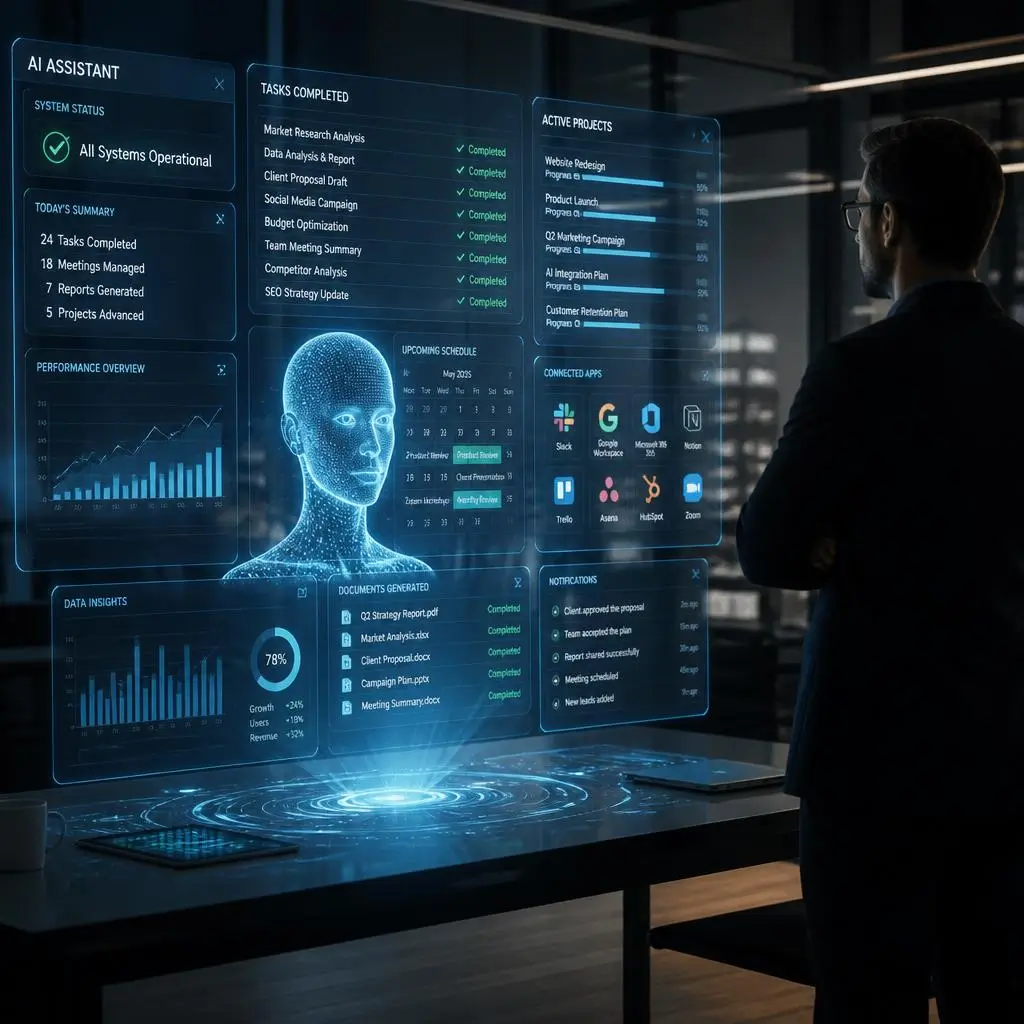
Imagine telling a colleague: “Find me the best hotel in Paris, compare prices, read the reviews, pick the best option, and prepare a report for me.”
With traditional AI, you would have to explain each step separately. The new generation of AI, on the other hand, distributes this workload independently.
It:
- Searches for information;
- Compares various options;
- Evaluates results;
- Re-checks data if necessary;
- Ultimately delivers a complete report to you.
In other words, the system no longer just gives an answer—it attempts to manage the entire process.
How Does Such AI Work?
Its workflow consists of several stages:
- Understanding the Goal. The system first analyzes the ultimate goal.Example: “Find me the best laptop for programming.”AI no longer limits itself to just listing models.
- Formulating a Plan. Next, it designs an action plan on its own.Example:
- Identifies requirements;
- Searches for different options;
- Compares technical specifications;
- Analyzes user reviews;
- Selects the best models.
- Executing Actions. The system then utilizes various tools.It can:
- Create documents;
- Fill out spreadsheets;
- Analyze data;
- Write code;
- Generate images;
- Draft emails.
- Self-Evaluating Results. This is the most fascinating stage. If the system discovers that the result is insufficient, it can verify and adjust its own decisions. This differs significantly from AI that can only provide a single answer.
Real-World Examples
In Business
Large companies are already testing AI that:
- Analyzes sales;
- Prepares reports;
- Identifies problems;
- Proposes solutions to executives.
In Programming
Modern AI can:
- Create software;
- Find bugs;
- Fix code automatically;
- Re-test the results.
In Medicine

Research systems assist doctors in:
- Analyzing studies;
- Detecting diseases;
- Comparing potential treatment options.(It is important to note that the final decision is still made by the doctor.)
In Education
AI is already capable of:
- Drafting personalized learning plans;
- Grading assignments;
- Identifying a student’s weak spots;
- Adapting teaching methods.
In Science
Artificial intelligence is increasingly used in:
- Discovering new materials;
- Drug research;
- Climate modeling;
- Astronomical research.
Which Companies Are Developing This Technology?
Almost all major global tech companies are actively working on creating the next generation of AI, including:
- OpenAI
- Microsoft
- Anthropic
- Meta
- Amazon
- NVIDIA
The goal of these companies is to create systems capable of independently executing complex tasks.
Will AI Completely Replace Humans?
This is one of the most frequently asked questions, and the answer is not simple.
At the current stage, AI can significantly simplify many routine tasks. However, there are still fields where human experience, intuition, creativity, ethical judgment, and emotional intelligence play a decisive role.
A more realistic scenario is that humans and AI will work together in the future.
What Are the Risks?
Like any powerful technology, the new generation of AI brings certain challenges.
- Safety: If the system acts incorrectly, the consequences could be severe.
- Privacy: AI often processes massive amounts of data, making proper protection of personal information essential.
- Jobs: Some experts believe many professions will change significantly. Others argue that the way work is done will evolve, giving rise to new professions rather than jobs disappearing entirely.
- Accountability: If AI makes a wrong decision, who is held responsible? This question remains a topic of active debate.
What Will the Coming Years Look Like?

Many experts believe that over the next few years, AI will increasingly transform into a personal digital assistant.
It will be able to:
- Schedule meetings;
- Organize trips;
- Draft documents;
- Analyze data;
- Handle a significant portion of daily work.
This does not mean humans will become redundant. It is far more likely that those who learn to collaborate effectively with artificial intelligence will gain a major competitive advantage.
Conclusion
Artificial intelligence is evolving rapidly, and its capabilities expand every year. While a few years ago AI was mainly limited to answering questions, today systems are emerging that can plan and execute multi-step tasks.
Although this technology is still in development and faces many technical, legal, and ethical challenges, one thing is clear—the role of AI in our lives will grow even further in the coming years.
In the near future, our most important digital assistant may no longer be a simple program that answers questions, but an intelligent system capable of planning, making decisions, and completing diverse tasks independently.
The new era of artificial intelligence has already begun, and it seems this is just the beginning.
If you found the article interesting, share it with your friends and leave a comment.