
Secret Sounds in the Ocean – “Bergen Bell”
The depths of seas and oceans remain one of the least explored areas for humanity. Despite technological progress, oceans still hold many secrets. One of the most mysterious phenomena that both frightens and fascinates researchers is the strange sounds coming from the sea, which cannot be fully explained even with modern technology.
Among them are the mysterious radio signals first recorded in 1947, later known as “Bloop” and similar signals, which changed the direction of oceanographic research. These unusual sounds are sometimes referred to in science as the “Bergen Bell.”
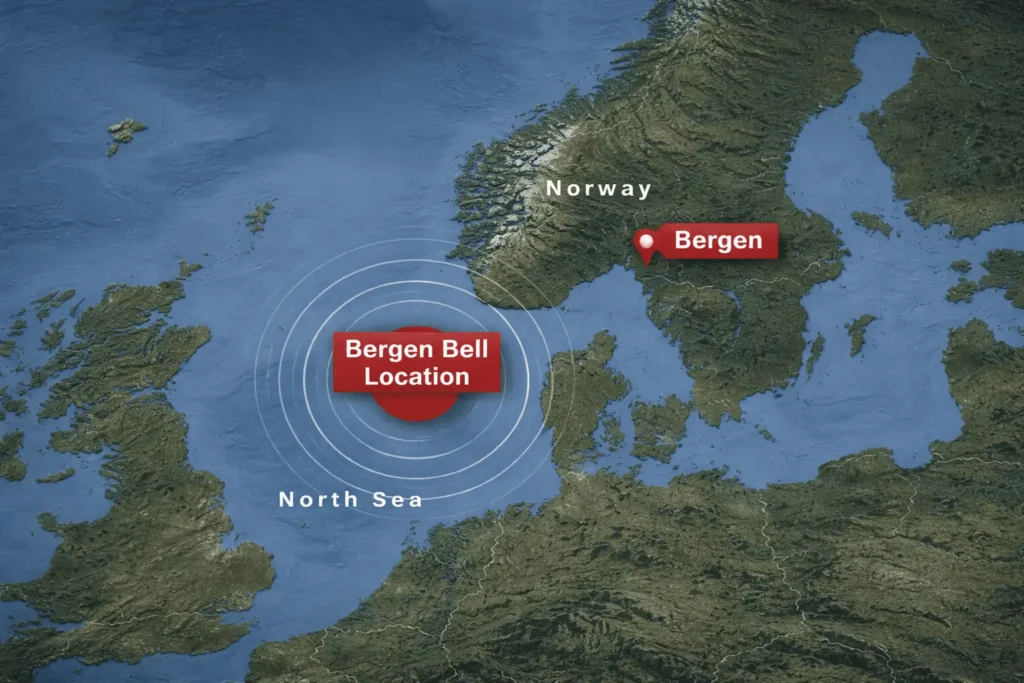
This name originated because fishermen near the Norwegian city of Bergen were among the first to hear and describe the sound. It resembled the ringing of a heavy metal bell, coming from the sea, lasting several minutes, and sometimes causing slight movements on the water’s surface.
The History of Discovery
In 1947, in the North Atlantic, American naval monitoring institutions began detecting mysterious radio signals. Each signal was:
- Powerful, ultra-low frequency
- Often detected once a day at a specific time
- Different from any known marine animal sound
Scientists initially suggested that these could be sounds produced by marine life, such as giant shrimp or unusual fish. However, the strength of the signals was extraordinary — they originated from thousands of kilometers away, making a biological origin unlikely.
The signals were most frequently recorded during the 1980s–90s in the North Sea, near the Norwegian coast. In some cases, the sound was so strong that ships temporarily left the area, and fishermen were afraid to remain at sea.

The Mystery of “Bloop”
One of the most famous signals was “Bloop,” recorded in 1997 by NOAA (National Oceanic and Atmospheric Administration). The sound was slow and low-frequency, gradually increasing in intensity.
Scientists proposed several explanations:
- A giant, unknown marine creature
- Geological processes
- Ice movements or powerful underwater currents
- Technical anomalies or sensor errors
In addition to “Bloop,” many other strange signals have been recorded:
- Slow Down – a sound whose frequency gradually decreased, as if a massive object were moving underwater
- Julia – a signal that appeared to emit regular patterns
- Train – dynamic, rhythmic signals
These sounds have been detected in both the Atlantic and Pacific Oceans. Some remain unexplained to this day.

Scientific Explanation
NOAA and other institutions continue to study these mysterious signals. Modern research uses seismic sensors and hydrophones.
The most widely accepted explanation is that many of these powerful sounds are caused by large ice formations breaking and moving in the ocean.
However, some signals only partially match known natural phenomena — they are stronger and travel much farther than expected.

Alternative Theories
Beyond science, some believe these signals indicate:
- Unknown giant underwater creatures
- Communication from extraterrestrial civilizations beneath the ocean
These theories are widely discussed not only in blogs and popular science books but also across the internet.
Strange ocean sounds, including Bloop and others, show that the ocean remains a mysterious environment for humanity. Despite modern technology, these sounds remind us how vast and unexplored nature still is, how inaccessible the depths of the oceans remain, and how many secrets our planet still holds.

Mysterious sounds in the sea are one of the most striking examples that science cannot yet explain everything — and this fuels human imagination, fear, and curiosity.
If you found the article interesting, share it with your friends and leave a comment.