Rembrandt — The Rise and Fall of a Genius
When we think about the life of Rembrandt Harmenszoon van Rijn, the first images that come to mind are his magnificent paintings — the contrast between powerful light and deep shadows, expressive faces, and gazes that seem to suggest that the person portrayed on the canvas is about to tell us something important. But Rembrandt’s own life could have been one of his most dramatic paintings. He achieved fame and wealth at a very young age, became one of Amsterdam’s most sought-after artists, acquired an expensive house and amassed a vast collection of works of art and rare objects. Then he lost almost everything. His wife died, several of his children died, he became involved in court disputes, went bankrupt, and spent the final years of his life in far more modest circumstances. Yet his art did not fade amid all these hardships. On the contrary — as he grew older and experienced loss and financial difficulties, his paintings seemed to become increasingly human.
Rembrandt was born in Leiden on July 15, 1606, as one of the younger children in a family of ten. His father was a miller, and the family was relatively prosperous by the standards of the time. Interestingly, the name “van Rijn” derives from the River Rhine — the family’s home was associated with his father’s mill. His parents provided Rembrandt with a good education, and in 1620 he enrolled at Leiden University. But instead of science and an academic career, the young man was drawn to brushes and paints. He soon left his studies and devoted himself to art. He first studied under Jacob van Swanenburg and later spent about six months in Amsterdam in the workshop of Pieter Lastman. It was Lastman who gave Rembrandt the foundation that would shape his particular interest in historical and biblical scenes.
The young Rembrandt was not satisfied merely with learning technique. From the beginning, he wanted to create scenes in which people did not simply pose but seemed to be acting. After returning to Leiden, he established his own workshop and soon acquired his first pupils. His talent attracted the attention of influential people as well. In 1631, Rembrandt moved to Amsterdam, and his career developed with remarkable speed. At the time, the city was one of the wealthiest centers in the Netherlands, and successful merchants and prosperous citizens wanted to commission portraits of themselves. Rembrandt offered them something not every artist could provide — he could see the individual behind a person’s social status. He soon became one of Amsterdam’s most sought-after portrait painters.

His professional rise was also transformed by his relationship with Saskia van Uylenburgh. Saskia came from a wealthy and influential Frisian family and had close connections with the world of art. Rembrandt became engaged to her in 1633, and they married a year later. From the outside, their family life seemed to belong to that of a successful and prosperous couple, but their happiness did not last long. They had four children, but the first three died in infancy. Only their fourth child, Titus, survived. This was particularly tragic because by the time Titus was born, Rembrandt had already experienced the deaths of three children. Saskia died in 1642 after a prolonged illness — the same year in which Rembrandt completed The Night Watch.
The Night Watch became one of the most important works of Rembrandt’s career. At first glance, it is simply a group portrait of Amsterdam’s civic militia, but Rembrandt almost overturned the traditional rules of group portraiture. Instead of standing quietly in a line, the figures move, speak, prepare their weapons, and look in different directions. Light illuminates several figures while leaving others in shadow. As a result, the painting resembles a historical scene more than an official portrait. This is why the Rijksmuseum considers it a turning point in Rembrandt’s career.

Yet the period in which this masterpiece was created was tragic in the artist’s personal life. After Saskia’s death, Rembrandt was left with his young son Titus. His personal life became even more complicated in the following years. After Saskia, Rembrandt lived with Titus’s nurse, Geertje Dircx. Their relationship ended badly and eventually reached the courts. Dircx brought a legal case against Rembrandt concerning a promise of marriage, and the dispute became a difficult and lengthy affair. She was later confined to a house of correction. Many details concerning the relationship between Rembrandt and Dircx remain the subject of debate, but it is clear that this was a difficult period for both of them.
Afterward, Hendrickje Stoffels became an important part of Rembrandt’s life. They lived together and had a daughter, Cornelia, in 1654. However, their relationship was problematic in the eyes of society because they were not officially married. Hendrickje was even summoned before the church council. Such a relationship was considered scandalous by the standards of the time and affected Rembrandt’s reputation. At the same time, his financial problems were becoming increasingly serious.
Rembrandt’s attitude toward money is one of the most fascinating details of his biography. He was not simply a man who enjoyed an expensive lifestyle. He had an almost obsessive interest in art, rare objects, antiquities, clothing, and various items that could be used in his own works. His collection eventually became so extensive that selling it became necessary when his financial crisis deepened. For Rembrandt, these objects were not merely luxuries — they were part of his creative world. Yet his constant desire to acquire new things, together with the expensive house he purchased in 1639, eventually became a heavy financial burden. He borrowed a large sum of money to buy the house, and this debt later became one of the main causes of his financial collapse.
By the middle of the 1650s, Rembrandt’s financial situation had become critical. In 1656, he was declared bankrupt. His property, house, works of art, antiques, and other possessions were sold to satisfy his creditors. The auctions continued in 1657 and 1658. The man who had once been regarded as one of Amsterdam’s greatest artists and who had accumulated precious objects now watched the carefully assembled world of his own life being dismantled before his eyes.
Yet this is where the most fascinating part of Rembrandt’s story begins. Bankruptcy did not mark the beginning of the end of his creativity. On the contrary, during the final decade of his life, his painting became even more daring. He paid less attention to what patrons expected from him and followed his own vision more closely. His technique for applying paint also changed. Sometimes he applied paint in thick layers; at other times he worked directly into the surface, scratched it, or used tools other than a brush. Later critics mocked this manner of painting, claiming that he seemed to apply paint with a “mason’s trowel.” Yet this rough and free technique became one of the defining characteristics of his late period.
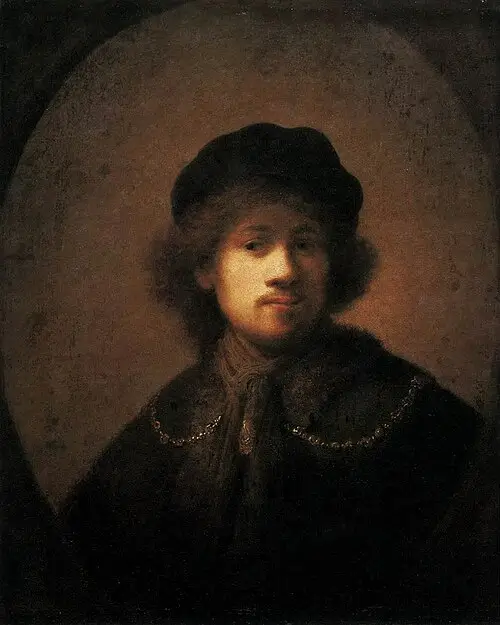
His self-portraits are particularly important for understanding Rembrandt’s late art. He painted his own face many times and perhaps no other major artist used himself as a model with such frequency. In his youthful self-portraits, we see an ambitious young man who seems confident about his future. As he grew older, however, his face changed. Youthful confidence gave way to wrinkles, fatigue, thoughtfulness, and gravity. Rembrandt did not beautify himself. He seemed unconcerned with what viewers might think about his age or appearance. He accepted his face simply as a reality. The Rijksmuseum notes that very few artists used their own faces as models as frequently as Rembrandt did.
In this sense, Rembrandt’s self-portraits are more than autobiographical records. They became a kind of chronicle of human aging. We see not only the changes in the artist’s appearance but also changes in his attitude toward himself. The young Rembrandt seems to be presenting himself to the world; the older Rembrandt seems almost to be speaking to himself. This is one of the strongest qualities of his art — the human face never interested him merely as an appearance.
One of the best-known works from his late period is The Jewish Bride, created around 1665–1669. The couple depicted in the painting stands quietly, yet almost nothing in the scene is unnecessary. The man’s hand rests near the woman’s chest, the woman turns toward him, and their relationship is expressed through a few restrained gestures. There is none of the noise or movement of The Night Watch. Everything is quiet. Yet it is precisely in this silence that a powerful sense of intimacy emerges. It seems like art corresponding to the experience of the artist’s later life — less theatricality and more inner emotion. The Rijksmuseum considers The Jewish Bride an important work of Rembrandt’s late period.

During these same years, Rembrandt increasingly moved away from the artistic taste that was becoming fashionable in Amsterdam. His style was too personal and too free. Some patrons continued to value his work, but he was no longer in the position he had occupied at the beginning of his career. According to the National Gallery of Art, the number of pupils in his workshop declined sharply during the second half of the 1650s, and in the 1660s only Aert de Gelder is securely documented among his well-known pupils.
Rembrandt’s financial problems continued until the end of his life. One of the most painful episodes concerned the fate of his enormous composition The Conspiracy of Claudius Civilis. He had created the work for Amsterdam’s town hall, but the city authorities ultimately rejected the composition. Rembrandt once again needed money, and according to the National Gallery of Art, he even sold Saskia’s grave in an effort to improve his financial situation. For a man who had once lived in a luxurious Amsterdam house, this was a cruel irony.

But the greatest blow was still to come. In 1663, the plague broke out in Amsterdam, and Hendrickje died. Five years later, in 1668, Rembrandt’s only surviving son, Titus, also died. Titus was only 27 years old. Shortly before his death, he had married Magdalena van Loo, but the young man’s life soon came to an end. Rembrandt survived his son by only one year.
Rembrandt died on October 4, 1669. The exact cause of his death is unknown. His burial at the Westerkerk was relatively modest, and even the grave was rented — another fact showing how far removed the end of his life was from the luxury to which he had become accustomed during his years of youth and success.
But Rembrandt’s story did not end with his death. On the contrary, the importance of his work grew over time. Today his paintings are preserved in the world’s greatest museums, and his name stands firmly in the history of Western art, just as his figures stand firmly in The Night Watch.
Rembrandt’s greatness should not be sought only in his technique of light and shadow. His greatest strength was his understanding of people. He did not simply try to paint beautiful faces. He was interested in age, fatigue, love, loss, poverty, pride, and loneliness. Perhaps this is why his late self-portraits can sometimes feel closer to a modern viewer than his most famous early works. We no longer see merely a seventeenth-century Dutch painter. We see a man who knew success, had money, love, and a family, then lost much of what he had and continued working nonetheless.
The greatest paradox of Rembrandt’s life is precisely this: materially, he lost almost everything, yet artistically he achieved extraordinary depth in the very period when his life was falling apart. His house was sold, his collection was dispersed, people close to him died, and his social position declined, but the human being in his paintings became more alive.
Perhaps that is why Rembrandt’s story is not simply the biography of a successful painter. It is the story of a man who created his name in his youth, lost his wealth in middle age, and at the end of his life found the most personal form of his art. His paintings still show us not only seventeenth-century Holland, but human life itself — with its victories, mistakes, love, losses, and the marks left by time.
The images used in the article are sourced from Wikimedia Commons and are in the public domain.
If you found the article interesting, share it with your friends and leave a comment.