Simulation Theory — Is It Possible That Our Universe Is a Computer Program?
Imagine discovering one day that something you believed about reality was completely wrong. You learn that Earth, the stars, other people, your memories, and everything you see around you are actually part of an enormous computer simulation. You are not living in the kind of universe you always imagined, while the laws of physics that you thought were fundamental rules of reality may simply be rules written into a program. This scenario sounds like science fiction, but the idea that our universe could be a simulated reality has already become a serious subject of discussion among philosophers, physicists, and technology researchers. Popular culture made the idea especially famous through the film The Matrix, but the modern version of the question is much more serious: if it ever becomes possible to create an extremely realistic artificial world through computers, how do we know that we ourselves are not part of a similar simulation?
How Did the Idea of Simulation Begin?
The idea of a simulated reality is actually much older than modern technology. Philosophers have spent centuries discussing how certain we can be that the world is exactly as we perceive it through our senses. One of the oldest philosophical problems concerns the reliability of human perception, while later, René Descartes raised a similar question through his famous thought experiment involving an “evil demon”: what if some powerful force were constantly deceiving our minds and making us believe that a false reality was genuine? Modern technology has given this ancient question an entirely new form. If we could one day create a virtual world so realistic that conscious beings inside it could not distinguish it from the real world, then it becomes possible to ask whether our own reality might have been created according to a similar principle.
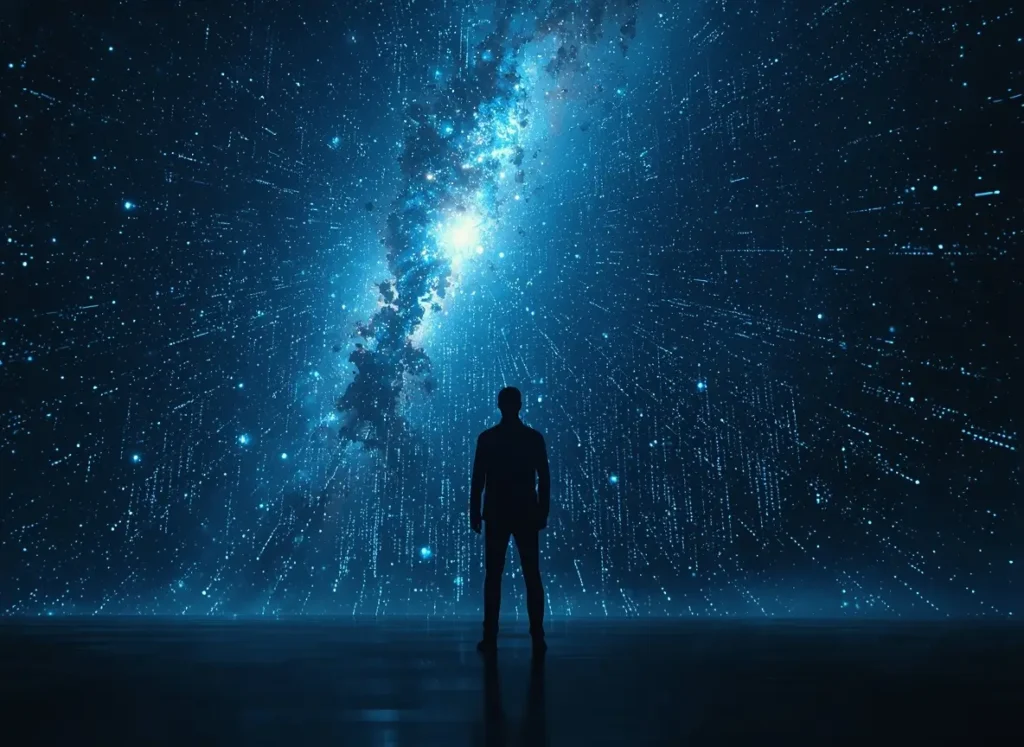
In modern discussions of the simulation hypothesis, one of the most frequently mentioned figures is Oxford philosopher Nick Bostrom. In 2003, he published a paper titled “Are We Living in a Computer Simulation?”, in which he examined what might happen if advanced civilizations eventually became capable of creating extremely detailed simulations of their ancestors or earlier civilizations. Bostrom’s reasoning considers three possible scenarios: civilizations may never reach the technological level required to create such simulations; they may reach that level but choose not to create them; or they may create such a vast number of ancestor simulations that the number of conscious beings living inside simulations would greatly exceed the number of beings living in the “base” reality. If the third scenario is possible, a strange statistical question emerges: why should we assume that we necessarily belong to the relatively small group of beings living in the original reality?
What Does Bostrom’s Argument Actually Mean?
Bostrom’s idea is often presented as if he proved that we live in a simulation, but that is not accurate. His argument is not experimental evidence, nor does it claim that the existence of a simulation is a fact. Instead, it presents a logical possibility. Imagine a future in which humanity, or another advanced civilization, possesses enough computing power to simulate human beings, their environment, their history, and perhaps even their consciousness. If such a civilization could create not one but millions or billions of these simulations, each simulated world could contain countless “people” who would consider their own reality just as real as we consider ours. In that case, the number of beings living in the original universe could become extremely small compared with the number of simulated beings. This is the basis of Bostrom’s famous statistical argument, although its conclusions depend on many controversial assumptions, including whether consciousness can actually be simulated and whether such enormous computational resources could ever exist.
How Difficult Would It Be to Simulate the Entire Universe?
This is one of the most important problems surrounding the simulation hypothesis. When we talk about simulating the universe, it is tempting to imagine a computer calculating the state and movement of every particle in existence. Our universe has been evolving for roughly 13.8 billion years, and the amount of matter it contains is unimaginably large. If a simulation required every particle and every interaction to be calculated in complete detail, the necessary computational resources could be so enormous that the task would be practically impossible. Supporters of the simulation hypothesis, however, sometimes consider another possibility: perhaps a simulation would not need to calculate every detail of the entire universe at all times. It might only need to generate the information required by a particular observer at a particular moment. This is often compared to video games, where objects far away from the player may not be rendered with the same level of detail. But this is only an analogy and does not mean that our universe actually works this way.
The problem becomes even more complicated when human consciousness enters the discussion. We still do not have a complete answer to the question of how conscious experience emerges from the human brain or whether it could be fully reproduced in another system. Could a computer someday be created that not only imitates human behavior but actually possesses subjective experience? If the answer is yes, that would make the simulation hypothesis more technologically plausible. If consciousness cannot be simulated in principle, however, one of the central foundations of Bostrom’s argument becomes much weaker.
Could the Universe Have “Pixels”?

Another fascinating question often raised in discussions of simulation theory is this: if the universe is a computer system, shouldn’t it have a smallest possible “resolution,” just as a digital image is made up of pixels? Physics includes concepts such as the Planck length — approximately 1.6 × 10⁻³⁵ meters — which represents an important scale in several areas of theoretical physics. On the internet, it is sometimes claimed that the Planck length is the “pixel size” of the universe, but this is misleading. The Planck length does not mean that physicists have discovered actual pixels in reality. There are different theoretical approaches to the fundamental structure of space-time, but there is currently no experimental evidence showing that the universe is built like a digital grid on a computer screen.
Quantum Mechanics and a Strange Reality
Simulation theory is also frequently connected with quantum mechanics because the quantum world is genuinely very strange from the perspective of everyday experience. At the microscopic level, the behavior of particles is often described using probabilities, while measurements play an important role in quantum systems. Because of this, some people have compared quantum mechanics to the operation of a computer program and suggested that reality somehow “calculates” itself only when it is observed. But this is an interpretation, not an established scientific fact. The strange properties of quantum mechanics are real, but they do not demonstrate that the universe is a computer simulation. Confusing a physical phenomenon with a philosophical interpretation of that phenomenon is one of the most common mistakes in discussions about simulation theory.
Are There “Glitches in the Matrix”?

If our reality is a program, another natural question appears: could errors or “glitches” sometimes occur in the system? On the internet, people sometimes interpret déjà vu, strange coincidences, memory inconsistencies, or the so-called Mandela Effect as possible errors in the simulation. For example, someone may remember an event very clearly in one way and later discover that the historical fact was actually different. Such experiences are sometimes described as “reality glitches.” However, human memory is not a perfect video recording. We constantly reconstruct memories, fill in gaps, and sometimes combine different pieces of information. These experiences can certainly be fascinating from a psychological perspective, but they are not considered scientific evidence that we live in a simulation.
Could We Ever Discover the Simulation?
This brings us to one of the most difficult problems with simulation theory. If we really are living inside a simulation, how could we prove it? In conventional science, a hypothesis is strongest when it can be tested and when an experiment can potentially support or disprove it. With the simulation hypothesis, the problem is that everything we observe could itself be part of the simulation. If we discover an unusual law of physics, we might interpret it as a rule written into the program, but it could simply be a fundamental law of our universe. If we observe something strange, we might call it a “glitch,” while a natural explanation could still exist. For this reason, the simulation hypothesis is often treated more as a metaphysical or philosophical idea than as a conventional scientific theory.
Who Could Have Created Our Universe?

Suppose, for a moment, that the simulation hypothesis is correct. Then a natural question follows: who created our universe? One possibility is that it was created by a civilization far more technologically advanced than ours, perhaps to study its history, its ancestors, or some other purpose. But another question immediately appears: who created that civilization? If their universe is also a simulation, then perhaps their creators were themselves living inside another simulated reality. This could theoretically produce a chain of nested universes in which one reality creates another. But this remains pure speculation, and there is no scientific evidence supporting such a scenario.
Why Would Anyone Create a Simulation Like Ours?
If advanced civilizations eventually become capable of creating such simulations, there could be many reasons for doing so. A technologically advanced civilization might want to study its own history, conduct social experiments, research consciousness, or simply create simulations for entertainment. It might use them to investigate how civilizations develop under different conditions. For example, billions of simulations could theoretically be created with different starting conditions to see what kinds of societies emerge. Such a scenario belongs to a distant and highly speculative future, but precisely these possibilities give simulation theory much of its philosophical appeal.
If We Live in a Simulation, Does It Matter?
The answer may be surprising. Suppose that one day we actually proved that our universe is a simulation. Would our everyday lives change? If the laws of physics inside the simulation remained the same, we would still need food, water, air, and energy. Gravity would continue to operate, time would continue to pass, and people would still have relationships, desires, problems, and goals. Discovering that our reality is simulated could change our understanding of existence, but in practical terms it might change very little. If a person experiences pain, that pain is real to them regardless of what ultimately lies beneath the structure of reality.
What If We Could Contact the Creators?
This is perhaps the most speculative part of simulation theory. If the creators of our universe existed and communication with them were possible, we might imagine that humanity could one day establish contact. But first we would have to know how the system outside our universe works and whether any channel for communication exists at all. The creators might deliberately prevent such communication, or it might simply be impossible for information to pass from inside the simulation to the outside. An even more interesting question is why the creators would want to communicate with us. We might be part of an experiment, they might not even know we exist, or they might exist on such a fundamentally different level that communication would be impossible.
What Does Modern Science Say?

Based on what we know today, there is no convincing scientific evidence that we live in a computer simulation. The simulation hypothesis is an interesting philosophical possibility, and Nick Bostrom’s argument is a serious subject of philosophical debate, but this does not mean that science has confirmed the simulated nature of our universe. It is also incorrect to claim that quantum mechanics, the Planck length, déjà vu, the Mandela Effect, or other strange phenomena provide direct evidence of a simulation. At present, science simply does not have experimental results that justify such a conclusion.
At the same time, the absence of evidence confirming the simulation hypothesis does not automatically mean that the idea is logically impossible. We simply do not know whether consciousness can be simulated with sufficient accuracy, whether such a system could be created using physically realistic resources, or whether a simulated universe could ever be distinguished from a non-simulated one. That is why simulation theory currently raises more questions than it answers.
So, Do We Live in a Real Universe or a Simulation?
Perhaps this question will never be resolved. We can continue studying the universe, discover new physical laws, build increasingly powerful computers, and develop more advanced artificial intelligence systems, yet still remain unable to determine whether our reality is part of something larger. Perhaps future technology will allow humanity to test the simulation hypothesis. Or perhaps we will eventually discover that the question cannot be tested in principle.
The most fascinating part of simulation theory may not be that it convinces us that the universe is artificial, but that it forces us to ask a much more fundamental question: what does “reality” actually mean? We experience the universe through our senses, our brains, and our consciousness, and it is natural to assume that the world is exactly as it appears. Yet human history has repeatedly shown that our initial assumptions about reality can be wrong.
Today, we do not know whether we are conscious beings living inside an enormous cosmic computer. We do not know whether a civilization created our universe, and we do not know whether such a thing could ever be proven. But one question remains: if humans eventually become capable of creating realistic, conscious simulations themselves, what guarantees that we are the first generation to discover this possibility? That question is precisely what makes simulation theory one of the strangest and most fascinating ideas in modern philosophy and technology.
If you found the article interesting, share it with your friends and leave a comment.