
Alcibiades – Genius, Traitor, or Political Chameleon?
The man who played Athens, Sparta, and Persia against one another.
Introduction
History is full of great commanders, brilliant rulers, and famous traitors. But rarely can one find a person who belongs to all of these categories simultaneously.
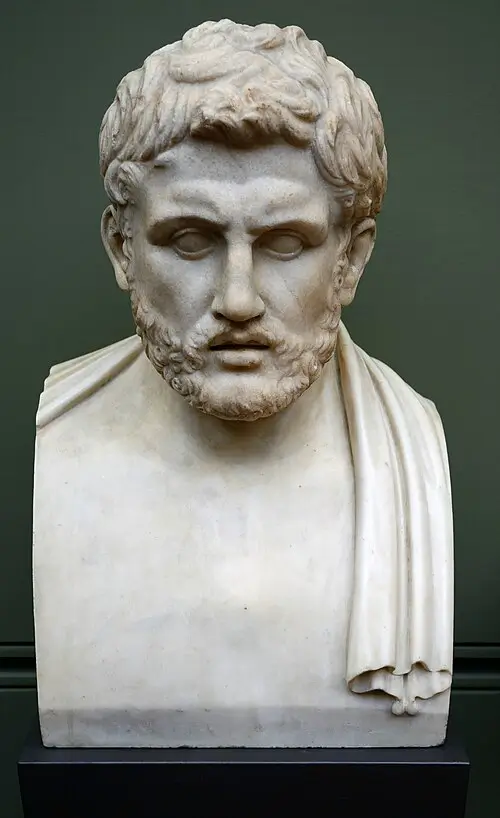
Such a man was Alcibiades – one of Ancient Greece’s most gifted, charismatic, and controversial statesmen. His contemporaries viewed him as both a genius and a traitor. According to some historians, a political talent like his in that era could only be compared to Alexander the Great, while others believe it was Alcibiades who accelerated the fall of Athens.
He was a man who first won glory in the service of his own city, then handed over military secrets to its most dangerous enemy – Sparta – and later found himself at the Persian court, manipulating events from there for his own interests. Astoundingly, after all this, the Athenians welcomed him back as a hero and even appointed him commander-in-chief of the army.
How could a single individual gain the trust of three sworn enemies? Was he a traitor to his homeland or simply a political realist doing whatever it took to survive? To answer these questions, we must travel back nearly 2,500 years to the Golden Age of Ancient Athens.
The Son of an Aristocrat Known to All of Athens
Alcibiades was born around 450 BC, at a time when Athens was at the peak of its power. His family was one of the most influential and wealthy in all of Greece. His father, Cleinias, was a famous military commander, while his mother belonged to the powerful and influential Alcmaeonid family, which played a major role in Athenian politics for centuries.
Alcibiades was still a child when his father fell in battle. Following this, his guardianship was assumed by the most influential man of the era – Pericles. This was no ordinary guardianship. Pericles was the very statesman under whose rule the Parthenon was built, democracy flourished, and Athens became the cultural center of the Greek world. Consequently, from childhood, Alcibiades grew up in an environment where politics, oratory, military affairs, and philosophy were part of daily life.
Socrates’ Favorite Pupil
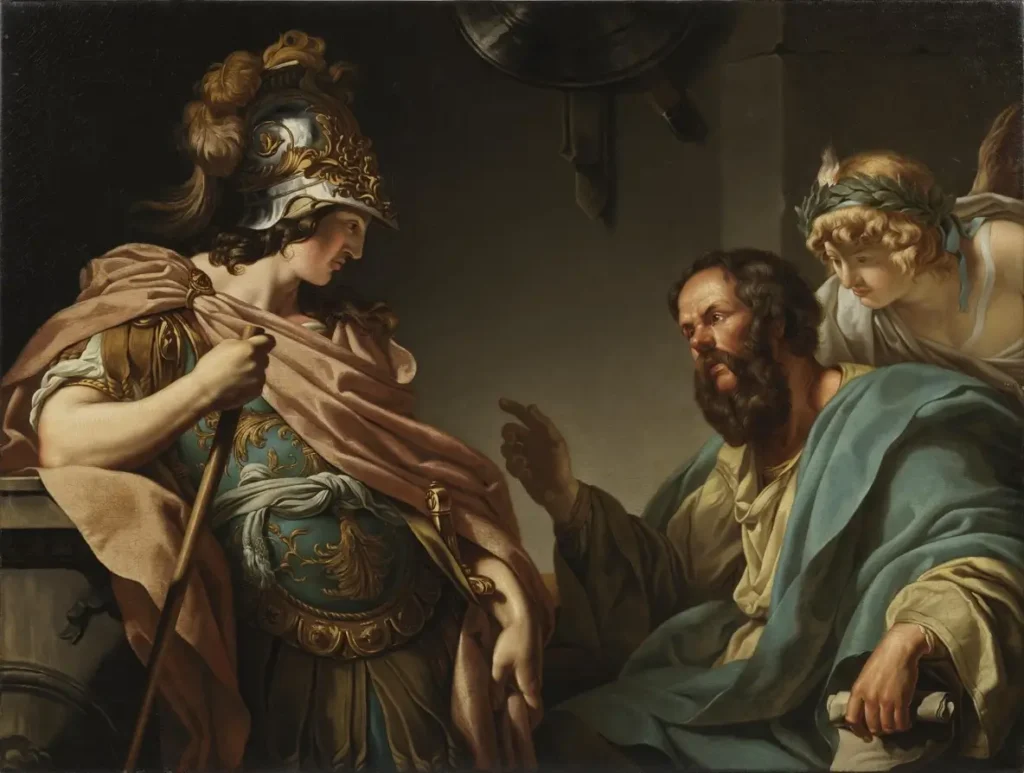
Philosopher Socrates occupied a special place in Alcibiades’ life. Their relationship remains a subject of discussion to this day. Ancient authors write that Socrates tried to teach the young aristocrat not only knowledge, but also morality.
Alcibiades was exceptionally intelligent, quick-witted, and remarkably eloquent. It was said that after his speeches, even the most stubborn opponents often changed their minds. Yet in the same sources, we read that Alcibiades was extremely ambitious. He wanted not just success, but power, glory, and an immortal name.
Socrates repeatedly warned him that unfulfilled ambition ultimately destroys a person. As later events showed, this warning proved prophetic.
Extraordinary Appearance and Charisma
Ancient historians note that Alcibiades possessed a strikingly attractive appearance. His charisma was so strong that people could listen to him for hours. He loved a luxurious life, expensive clothes, the finest horses, and luxury.
At the Olympic Games, he entered seven war chariots simultaneously. For that era, this was an unimaginable display of wealth. His chariots took first, second, and fourth places. This was not merely a sporting victory; all of Greece saw once again that young Alcibiades did everything possible to remain at the center of attention.
Some were delighted by his confidence, while others thought that such arrogance would sooner or later bring great disaster. Unfortunately, they turned out to be right.
A Man Who Could Do Anything
Before he had even reached the age of thirty, he had already become one of Athens’ most influential politicians. He was a brilliant orator, a gifted diplomat, and a skilled military commander who excelled at persuading people and exerting influence over them.
It was sometimes said that Alcibiades subdued people not with words, but with his very personality. Yet it was during this period that his chief flaw became apparent: Alcibiades believed that rules existed for others.
He was convinced that his own talent would cover any mistake. This self-confidence soon spilled over into one of the largest military campaigns in history – an expedition that changed Athenian history forever.
The Road to Ruin – The Sicilian Expedition
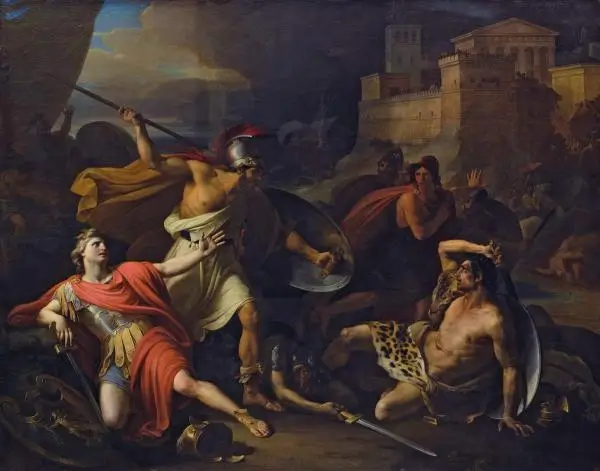
At the end of the 5th century BC, the multi-year conflict between Athens and Sparta had engulfed all of Greece. This was the Peloponnesian War – a conflict that divided the Greek world into two camps.
By this time, Alcibiades was already one of Athens’ most influential politicians. He believed that Athens could not win by defense alone; a blow was needed that would permanently weaken Sparta’s allies.
His attention fixed on Sicily, specifically the wealthy city of Syracuse. Alcibiades argued that if Athens conquered Syracuse, all of Sicily would fall into its hands. After that, the Athenians would even be able to campaign against Carthage and ultimately transform into a force that no one could oppose.
The plan was remarkably ambitious. His opponents argued that it was far too risky an adventure, but Alcibiades was convinced that victory would usher in a new era of glory. Ultimately, the popular assembly approved his plan.
Athens prepared one of the largest naval expeditions in history. Hundreds of ships, thousands of hoplites, archers, horsemen, and sailors set off toward the west. Many Athenians were convinced they were heading toward a grand victory. No one knew that this decision would turn into one of the greatest disasters in Athenian history.
The Mysterious Night That Changed Everything
A few days before the expedition’s departure, a strange and shocking event occurred in Athens. Most of the stone statues of Hermes standing in the city streets were defaced during the night, with their faces and genitalia damaged.
Hermes was considered the patron god of travelers and roads. The desecration of these statues was no simple act of vandalism; Athenians viewed it as an ill omen and an insult to the gods. Panic immediately broke out in the city, along with suspicions that this could be a precursor to a coup d’état.
Soon, rumors reached Alcibiades. His political opponents claimed that he and his friends were behind the act. There was no direct evidence, but Alcibiades’ eccentric lifestyle, loud parties, and scandalous reputation made it easy for many to believe the accusation.
Alcibiades demanded an immediate trial to prove his innocence, but the trial was postponed. He was kept as a leader of the expedition and sent off to Sicily. This decision soon proved fatal.
The Escape That Shocked All of Greece
The expedition was already underway when an official order arrived from Athens: Alcibiades was to return home. He was accused of impiety and conspiracy against the state.
Many believed that if he returned, he would be executed. Alcibiades refused to take the risk. Instead of returning to Athens, he fled. His ultimate destination was the very city he had fought against his entire life – Sparta.
The news spread like lightning across Greece. Athens’ most famous commander and politician had defected to his country’s greatest enemy. Many in Athens viewed this as treason, while others thought Alcibiades was merely trying to save his own life. Whatever his motive, one thing was clear: from then on, Athens had a man in the enemy camp who knew all its secrets.
Sparta’s Most Valuable Advisor
The Spartans initially treated him with caution. How could anyone trust a man who had abandoned his own city? But Alcibiades very quickly proved his worth. He advised the Spartans to help Syracuse, a recommendation that proved decisive.
Sparta’s military support placed the Athenian expedition in a dire predicament. Then Alcibiades proposed an even more critical idea: he advised the Spartans to build a permanent military fort at Decelea, near Athens.
This move proved catastrophic for Athens. The Spartans controlled the surrounding territory year-round. Athens could no longer make use of its agricultural lands, thousands of slaves fled, and work in the silver mines nearly came to a halt. The city’s economy rapidly weakened.
The Spartans realized they had an extraordinary political and military mind by their side. Yet soon Alcibiades made the same mistake he had made many times in his life: his charisma and influence created new enemies. Influential circles in Sparta began to suspect that this man served only his own interests.
Furthermore, according to ancient authors, Alcibiades was accused of an affair with a member of King Agis II’s family, which strained the situation even further. When he learned that his assassination was being planned, he decided to flee once more. This time, his path led toward Persia. A man who had already changed two homelands was now about to test his fortune at the court of a third great power.
At the Persian Court – A Man Who Used Everyone for His Own Ends
After fleeing Sparta, Alcibiades arrived in Asia Minor, a territory under the influence of the Persian Empire. At that time, Persia remained a vast power in the East. Although the Greeks had repelled the great Persian invasions at the beginning of the century, the empire still possessed immense military and financial resources.
Here, Alcibiades established a relationship with the influential Persian satrap, Tissaphernes. As a regional governor for the Persian king, the satrap made important decisions independently. Alcibiades evaluated the situation very quickly; he realized that if Persia fully backed either side, the outcome of the war could be decided swiftly. Therefore, he gave Tissaphernes unexpected advice: aid neither Sparta nor Athens enough for either to achieve decisive victory.
In his view, weakening both sides was in Persia’s best interest. This was the classic principle of “divide and rule.” Many historians believe it was during this period that Alcibiades’ exceptional talent as a political strategist truly showed. He was no longer fighting with a sword alone; now his primary weapons were diplomacy, psychology, and influence.
How He Sought to Return to Athens
Despite everything, Alcibiades never forgot one goal: he wanted to return home. He realized he would always remain a foreigner in both Sparta and Persia, and that true glory could only be attained in Athens.
Thus, he initiated secret negotiations with the Athenian military commanders leading the fleet in the Aegean Sea. Alcibiades persuaded them that securing Persian assistance was only possible through him. In return, he demanded that Athens drop all charges against him.
His opponents claimed this was yet another political game, but the war-weary Athenians needed a successful commander. Ultimately, Alcibiades’ supporters gained influence, making the prospect of his return increasingly real.
Victories That Changed Everything
Between 411 and 408 BC, Alcibiades once again assumed the role of military commander. During this period, the Athenian fleet achieved several major victories, notably at the battles of Abydos and Cyzicus, where the Spartans suffered severe defeats.
These successes completely shifted the mood in Athens. The man who just a few years earlier was called a traitor had now, in the eyes of many, become a savior once again. History rarely sees a politician pull off such a dramatic transformation. Alcibiades seemed to be starting everything anew.
Triumphant Return

In 407 BC, Alcibiades returned to Athens. Nearly eight years had passed since his flight from the city. Huge crowds gathered at the harbor – some out of curiosity, others to see how a man once sentenced to death would return. Unexpectedly, everything changed.
The people greeted him with ovations. Most of the charges against him were dropped, his confiscated property was restored, and soon he was appointed supreme commander of Athens’ land and sea forces. This political rehabilitation was almost unbelievable: a man who had first served Sparta and then resided at the Persian court was now back as Athens’ chief hope.
A Single Mistake That Destroyed Everything
Yet Alcibiades’ success did not last long. During a military operation, he entrusted the fleet to his deputy, Antiochus, and departed temporarily. Alcibiades strictly warned him not to engage in battle with the Spartans. Antiochus disobeyed this order, engaged the Spartans, and suffered a heavy defeat.
Although Alcibiades himself was nowhere near the battlefield at the time, responsibility was placed squarely on him. His political enemies in Athens mobilized once more, asserting that the city could no longer trust such an unpredictable man.
Alcibiades lost everything for a second time. He resigned from his post and went into voluntary exile. This time, he realized that a return to Athens would likely never be possible again.
The Final Years – A Man Trusted by No One
After leaving Athens a second time, Alcibiades settled in Phrygia, in Asia Minor. Outwardly he lived peacefully, though he knew well that his life remained in danger. He had countless enemies.
In Athens, many still considered him a traitor; in Sparta, his flight would never be forgiven; and at the Persian court, he no longer enjoyed his former influence. At this time, the Peloponnesian War was drawing to a close. The Spartans were growing stronger, while Athens was falling back.
According to ancient authors, Alcibiades attempted to warn his former fellow citizens. He advised them to act more cautiously against the Spartan fleet and to reconsider several major military decisions. However, no one heeded his warnings. The Athenians once again refused to listen to the man they had once considered the country’s most gifted strategist.
A Mysterious Murder

In 404 BC, Alcibiades’ life came to a tragic end. Several different versions exist regarding his death. According to the most common account, his house was set on fire at night. When Alcibiades rushed out of the burning house with a sword in hand, armed men lying in ambush killed him with arrows.
Yet the primary question remains unanswered to this day: who ordered his assassination?
Some historians believe it was an organized assassination by the Spartans, who felt Alcibiades was still too influential a figure and feared he might return to politics once more. Other researchers place responsibility on the Persians. There is also the view that the interests of both sides coincided in organizing the murder.
No definitive answer exists to this day, which is likely why his death remains one of the greatest mysteries of ancient history.
Genius or Traitor?
Evaluating Alcibiades became a subject of debate even in antiquity. His contemporary, the historian Thucydides, described him as a man of extraordinary talent. Xenophon emphasized his military capabilities, while Plutarch wrote that incompatible traits coexisted in Alcibiades’ character.
He was simultaneously courageous and reckless, intelligent yet arrogant, charismatic yet intensely ambitious. His main problem was likely that he believed too strongly in his own abilities, thinking he could overcome any situation with his intellect and eloquence.
Many times he did manage to do just that. But ultimately, his self-confidence and unquenchable thirst for power left him entirely alone.
Did He Change History?
A significant portion of historians believe that without Alcibiades, the Peloponnesian War would have unfolded completely differently. The Sicilian Expedition, the military advice given to Sparta, the fortification of Decelea, the attempts to influence Persian policy, and the subsequent victories gained for Athens — his hand was visible behind every single one of these events.
It is difficult to find another figure in history who exerted such an influence on the policies of nearly all major forces fighting against one another in the same war. It can be said that Alcibiades was not merely a participant in history — he was actively shaping it.
Conclusion
Alcibiades’ life resembles a Greek tragedy. He was born surrounded by power and glory. In his youth, everyone marveled at his talent. Socrates tried to teach him wisdom, Pericles saw him as a future leader, and Athens hailed him as a hero multiple times, only to reject him twice.
He served Athens, then Sparta, then the Persian court, and in the end found no one left who trusted him fully.
Today, nearly two and a half thousand years later, historians still debate: was Alcibiades a traitor to his homeland, or was he simply a political realist playing for survival and power by the rules dictated by his era?
Perhaps both assessments are partially true. However, almost everyone agrees on one thing:
Alcibiades was a man who reached the pinnacle of achievement through his brilliance, but that same brilliance, combined with extreme ambition, ultimately caused his downfall.
That is precisely why he remains one of the most fascinating, mysterious, and contradictory figures of the ancient world.
The images used in the article are sourced from Wikimedia Commons and are in the public domain.
If you found the article interesting, share it with your friends and leave a comment.