Zinedine Zidane — The Genius Who Changed the History of Football
In the history of football, there are players who are judged by their goals and the trophies they win. There are also those whose performances immediately bring specific moments to mind: extraordinary ball control, an unexpected pass, a skillful move past an opponent, and a movement that seems to transform an ordinary sporting contest into art. Zinedine Zidane was precisely this kind of footballer. He was not always the fastest player on the pitch, but he often managed to do what seemed almost impossible for others: control the tempo of a game, find space where none appeared to exist, and change a difficult situation with a single touch.
His career is one of the most remarkable in football history. He won the World Cup and the European Championship with France, performed at the highest level for Juventus and Real Madrid, and later won the Champions League three consecutive times as a manager. Yet Zidane’s story is about more than victories. It encompasses the experiences of an immigrant family, a childhood dream, enormous pressure, worldwide fame, and one dramatic moment that brought his playing career to an unexpected end.
From the Outskirts of Marseille to the World of Elite Football
Zinedine Yazid Zidane was born on June 23, 1972, in the French city of Marseille. His parents were originally from Algeria, and the family lived in Marseille’s multicultural environment. Zidane grew up in La Castellane, a neighborhood in the northern part of the city. It was a working-class district where football was more than entertainment for children: it was part of everyday life, friendship, and the opportunity to test their abilities.

Zidane was the youngest of five children. Hard work, discipline, and mutual support were important values in his family. As a child, he played football in the streets with his friends, watched older players, and gradually realized that he had a special ability to control the ball. His advantage was not limited to technique. Zidane could quickly assess the pitch, anticipate a teammate’s movement, and deliver the ball at exactly the right moment.
During his teenage years, his talent attracted the attention of football scouts. Zidane progressed from local teams into the youth football system and eventually joined Cannes’ academy. It was at this club that his professional career began to take shape. In 1989, at just 16 years old, he made an appearance for Cannes’ first team in France’s top division.
The young footballer still had a long way to go. He needed to develop his physical strength, tactical understanding, and consistency, but one thing was already clear: Zidane controlled the ball as if he had a special connection with it. He did not rush when others panicked. That composure would later become one of the defining features of his playing style.
Bordeaux — From Talent to International Recognition
In 1992, Zidane joined Bordeaux. At this club, he demonstrated his abilities to a wider audience and gradually established himself as a player attracting the attention of Europe’s major clubs. His game combined technical precision, physical endurance, spatial awareness, and creativity. Zidane could keep possession while surrounded by several opponents, launch an attack with an unexpected pass, or make a decision himself that changed the direction of a match.
He also attracted attention in European competitions with Bordeaux. During the 1995–96 season, the French club reached the UEFA Cup final. Along the way, Bordeaux defeated AC Milan, and Zidane became one of the team’s most important players. The French side lost the final to Bayern Munich, but the campaign proved to be a turning point for Zidane: his performances showed that he could succeed at Europe’s top clubs.
In 1994, Zidane made his debut for the French national team. He joined the side at a time when France was seeking to become one of the leading forces in world football. In the following years, he became central to the national team—a player capable of organizing attacks, retaining possession, and taking responsibility at decisive moments.
Juventus — At the Summit of European Football

In 1996, Zidane moved to Juventus in Turin. Italian football at the time was known for its demanding tactics, organized defenses, and intense competition. Technical talent alone was not enough to succeed in such an environment. Players had to make decisions quickly and capitalize on even the smallest mistakes made by their opponents.
Zidane rose to the challenge. At Juventus, he became highly influential in the team’s play and won the Italian league title twice, in 1997 and 1998. He also reached the Champions League final with the Turin club in 1997 and 1998, although Juventus lost on both occasions. Nevertheless, Zidane’s international reputation continued to grow.
What made his game special was that he was much more than a technically gifted player. Zidane created space, controlled the rhythm of attacks, and put his teammates in better positions. He could quietly influence much of a match before making a decisive impact with a single pass or shot.
The year 1998 was particularly important for Zidane. After winning the World Cup with France, he also received the Ballon d’Or. The award confirmed both his outstanding season and his status in world football.
1998 — France Becomes World Champion
The 1998 FIFA World Cup was held in France. The host nation had a strong squad, although not everyone believed before the tournament that the team would go all the way. Zidane was one of the national team’s key figures, but he also faced difficult moments during the competition. After receiving a red card in the group-stage match against Saudi Arabia, he missed France’s round-of-16 match.
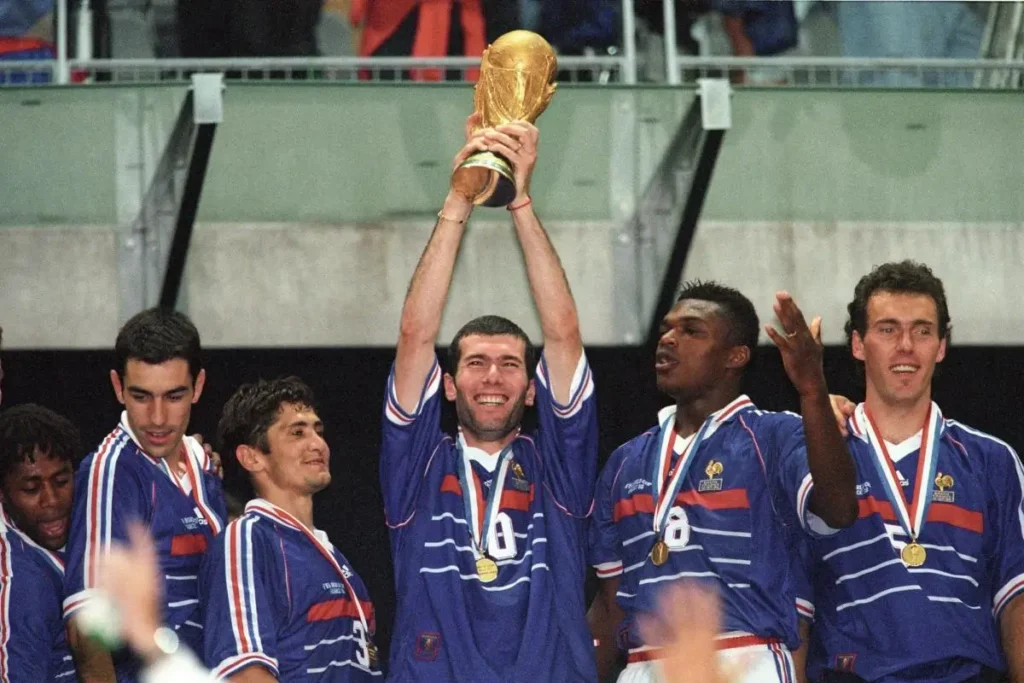
France continued its journey regardless. The team benefited from an organized defense, goalkeeper Fabien Barthez’s performances, the reliability of Lilian Thuram and Marcel Desailly, and the attacking potential of Thierry Henry and David Trezeguet. Zidane’s return added creativity to the team.
On July 12, at the Stade de France near Paris, France faced defending world champions Brazil. Brazil’s lineup included Ronaldo, Rivaldo, and other stars, but Zidane became the final’s central figure. He scored twice with headers in the first half, both from corner kicks. France won 3–0 and became world champions for the first time in its history.
The victory was more than a sporting achievement. Players of different backgrounds represented France, and the team became a symbol of the country’s diverse society. Zidane, a Marseille-born footballer of Algerian descent, became a national hero. His performances reminded millions that football could bring people from different backgrounds together around a shared goal.
In 2000, France also won the European Championship. The final against Italy was decided in extra time by David Trezeguet’s golden goal. Zidane performed at the highest level throughout the tournament and was recognized as one of its outstanding players. By then, he was not merely a star but a footballer capable of leading his team in the most important matches.
Real Madrid — The Galácticos Era and an Unforgettable Goal
In 2001, Zidane joined Real Madrid. The transfer became one of the most widely publicized deals in football history. At the time, the club was assembling a team of superstars, and Zidane joined established names such as Luís Figo and Raúl. Ronaldo joined the team later. This collection of stars became known as the “Galácticos.”
Moving to Madrid presented Zidane with a new challenge. Under enormous expectations, he had to prove that he could establish himself at one of the world’s most famous clubs. His first season proved historic for the team: in 2002, Real Madrid defeated Bayer Leverkusen in the Champions League final.
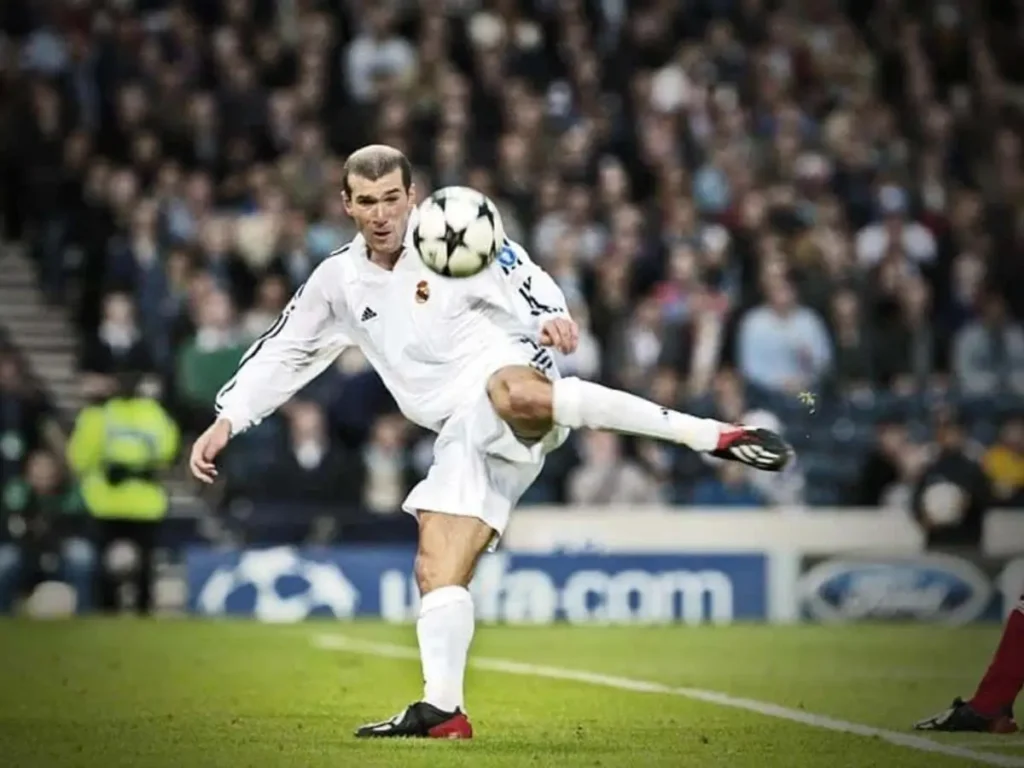
On May 15, in the final held in Glasgow, Zidane scored one of the most memorable goals in football history. Roberto Carlos sent the ball high into the penalty area. Zidane struck it in mid-air with his left foot, sending it into the top corner of the net. It was a technically demanding yet astonishingly precise shot that played a major role in Real Madrid’s victory.
The goal became a symbol of Zidane’s style: technique, balance, timing, and composure in a decisive moment. Real Madrid won the Champions League, and Zidane added the major club trophy that had previously eluded him.
He spent five seasons in Madrid, making 227 official appearances and scoring 49 goals. With the club, he won the Champions League, the Spanish league title, and other trophies. Yet his value could not be measured by statistics alone. Zidane was a player whose performances supporters enjoyed watching regardless of the result.
2006 — The Return and the Final Act of a World Cup Career
In 2004, Zidane decided to retire from international football. France had a new generation of players, and it appeared that his great footballing adventure was approaching its end. However, in 2005, he decided to return to the national team. France needed to qualify for the 2006 World Cup and build a competitive side, and Zidane’s experience proved crucial.
France’s start at the World Cup in Germany was not easy. The team drew with Switzerland and South Korea but improved as the tournament progressed. In the round of 16, France defeated Spain, and in the quarterfinals it eliminated defending champions Brazil. Zidane performed brilliantly in that match and assisted Thierry Henry’s winning goal.
France defeated Portugal in the semifinal. Zidane scored from the penalty spot and sent his team into the final. Thus, the 34-year-old reached the last match of his career: the World Cup final, where France would face Italy.
The Incident with Materazzi — The Moment That Shocked the World
On July 9, 2006, in the final at Berlin’s Olympic Stadium, Zidane made an excellent start. In the seventh minute, he converted a penalty with a Panenka-style chip, delicately lifting the ball over the goalkeeper to give France the lead. Italy soon equalized through a goal by Marco Materazzi. The match ended 1–1 after regular time and went into extra time.

Zidane still had the chance to end his career with an unforgettable victory. He struck a powerful header, but Italy’s goalkeeper Gianluigi Buffon saved it. Shortly afterward, however, an incident occurred that attracted almost as much attention as the match’s result.
A verbal confrontation took place between Materazzi and Zidane. Zidane turned around and headbutted the Italian defender in the chest. Referee Horacio Elizondo reviewed the incident with the assistance of the video officials and showed Zidane a red card. The French captain left the pitch, and his final professional match ended with a sending-off.
The incident became one of the most debated moments in football history. Both players later spoke about what happened, although not every account circulated about the incident is equally reliable. Zidane explained that Materazzi’s words about his family had angered him. Materazzi also gave his version and confirmed that a verbal confrontation had taken place. Different accounts of the exact exchange exist, so it would be wrong to present unverified phrases as established fact.
France lost to Italy in the penalty shootout and failed to become world champions. Zidane ended his career without being able to say goodbye to his teammates in the usual way or celebrate his final match by lifting the trophy. A brilliant tournament had been overshadowed by one painful incident.
Nevertheless, Zidane was named the best player of the World Cup and received the Golden Ball as the tournament’s outstanding player. This once again showed that his overall performances were being recognized, rather than his contribution being judged solely by the final minutes of the final.
After Playing — The Manager Who Made History with Real Madrid
Zidane’s playing career had ended, but his connection with football had not. He performed various roles at Real Madrid, worked within the club’s structure, and gained experience as he prepared for management. Later, he became the coach of the club’s reserve team, Real Madrid Castilla.

In January 2016, Zidane was appointed Real Madrid’s first-team manager. Immediate success was expected of him, but few could have imagined that he would achieve one of the most remarkable managerial records in European football. That same year, Real Madrid won the Champions League, defeating city rivals Atlético Madrid on penalties in the final.
In 2017, the team defended its Champions League title by beating Juventus in the final. In 2018, Real Madrid won the competition for the third consecutive time, defeating Liverpool in the final. Winning three consecutive titles in the modern Champions League era was an extraordinary achievement, and Zidane became the central architect of that success.
His managerial style challenged the idea that a successful coach must rely on complicated tactical systems and constant public statements. Zidane placed great importance on relationships with his players, maintaining trust in the dressing room, and making the best use of his team’s stars. He often appeared calm, while his team displayed exceptional psychological resilience in important matches.
In 2018, he left Real Madrid. He later returned to the club in 2019 and managed the team until 2021. During his second spell, the team won the Spanish league title and other trophies. Zidane’s achievements as a manager ultimately demonstrated that his understanding of football extended far beyond his technical abilities as a player.
Why Has Zidane Remained a Football Legend?
Zinedine Zidane’s career is remarkable not only because of the number of trophies he won but also because of the way he played. He did not need to run at full speed constantly or attract attention with complicated moves. His greatest strengths were ball control, spatial awareness, passing accuracy, and decision-making. He often managed to turn a difficult situation into a simple action.
Zidane won the 1998 World Cup and the 2000 European Championship with France. He demonstrated his class at Juventus and Real Madrid, and scored one of the most beautiful goals in the 2002 Champions League final. Later, as a manager, he wrote a new chapter in sporting history by winning the Champions League three consecutive times.
The incident in the 2006 World Cup final remains one of the most controversial and widely discussed moments of Zinedine Zidane’s career. When his confrontation with Marco Materazzi ended with Zidane being sent off, football fans were divided into two camps. Some believe that Zidane should not have taken the bait and left his team a player short before such an important match had come to an end. Others view his reaction in the context of the words that Materazzi reportedly directed at him and believe that questions of personal and family honor should not be ignored when judging the incident. Perhaps that is precisely why this moment remains relevant to this day: it is about more than football—it makes us reflect on human emotions, dignity, provocation, and the decisions people make under difficult circumstances. Whatever our judgment of what happened, it is impossible to define Zidane’s long career and his legacy in football history solely by this one incident.
Zidane’s story is one of victories and mistakes, talent and hard work, greatness and human vulnerability. He became a world champion, was recognized as one of Europe’s finest footballers, reached the highest levels of club football, and later achieved historic results as a manager. His career demonstrated that greatness in football is not measured by goals alone. It is also defined by understanding the game, decisions made at difficult moments, and the legacy an athlete leaves for future generations.
Zinedine Zidane will remain in football history for precisely these reasons: as a player who could turn his relationship with the ball into an art form, and as a manager who proved that the experience gained on the pitch can be transformed into great success in a new role.
If you found the article interesting, share it with your friends and leave a comment.