
Alain Delon — A Story of Beauty, Fame, and Loneliness
There were actors who played great roles; there were actors who changed the history of cinema; and there were those who themselves became symbols of an era in film.

Alain Delon belonged to the latter group. His face became so recognizable that sometimes the name “Delon” alone was enough to make audiences imagine a certain type of man — a cold gaze, blue eyes, elegant clothes, a confident stride, and a sense of danger hidden behind outward calm. France’s National Centre for Cinema describes him as an “actor who became a legend,” while the British Film Institute notes that Delon became one of the greatest stars of post-war French cinema.
But Alain Delon’s story is particularly fascinating because, at the beginning, his life looked nothing like that of a future cinema legend.
A Difficult Childhood

Alain Fabien Maurice Marcel Delon was born on November 8, 1935, in Sceaux, near Paris. His parents separated when he was still young, and he grew up in a rather unstable environment. He was frequently expelled from school because of his difficult temperament and disciplinary problems. Later, Delon worked various jobs and for a time worked at Paris’s famous Les Halles market.
At the age of 17, he joined the French Navy and was sent to Indochina. His military service was far from easy, and Delon was eventually discharged for disciplinary reasons. When he returned, he had neither formal acting training nor any clear plan for what he would do with his life.
Cinema entered his life almost by accident.
How He Ended Up on Screen Almost by Accident
In the mid-1950s, Delon became part of the Saint-Germain-des-Prés artistic circle in Paris, where he became friends with artists and actors. It was there that he met people who would change the direction of his life.
In 1957, the young Delon attracted attention at the Cannes Film Festival. His appearance was so striking that he was offered opportunities to appear on screen, even though he had no professional acting education whatsoever. His first film roles were small, but the camera seemed to “work” strangely well with him.
Delon possessed something that people in cinema often cannot teach — screen presence. He could simply stand in front of the camera and still capture the audience’s attention.
In 1958, he was paired with the young Romy Schneider in the film Christine. Their chemistry on screen was so convincing that their relationship soon continued in real life. Delon and Schneider became one of the most famous couples in European cinema.
But Delon’s real breakthrough was still ahead.
1960 — Two Films That Changed Everything
In 1960, two films were released that established Alain Delon’s name in international cinema history.

The first was René Clément’s Plein Soleil, an adaptation of Patricia Highsmith’s novel The Talented Mr. Ripley. Delon played Tom Ripley — a charming, sophisticated and dangerous young man who wants to take over another person’s life and social status.
Delon’s appearance was used in a completely different way here. He was both attractive and frightening. Audiences could be fascinated by him while simultaneously feeling that something dark was hiding behind his smile. This role turned him into a major international star.
That same year, Luchino Visconti’s Rocco and His Brothers was released. Delon played a completely different character — Rocco, a young man who moves with his family from southern Italy to Milan.
If Delon was cold and dangerous in Plein Soleil, in Rocco and His Brothers he demonstrated his dramatic abilities. Working with Visconti earned him the respect of critics and proved that Delon was much more than just a handsome face.
This was the moment when Alain Delon transformed from a popular actor into a genuine movie star.
The Leopard — A Cinema Classic
In 1963, Delon worked with Luchino Visconti again, this time in The Leopard, in which he played Tancredi.
Delon starred alongside Burt Lancaster and Claudia Cardinale. The Leopard is now considered a classic of world cinema and won the Palme d’Or at the Cannes Film Festival. Delon’s performance further confirmed his international status.
But one of the most important stages of Delon’s career was still to come.
The Man Who Turned Silence into a Weapon
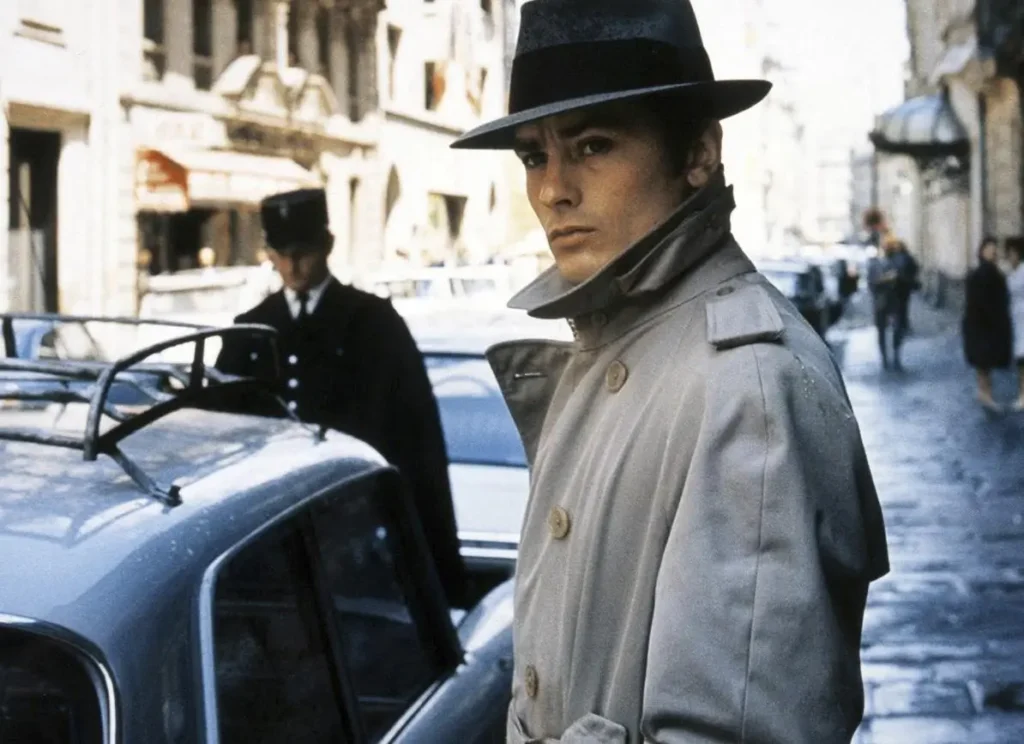
In 1967, Jean-Pierre Melville’s Le Samouraï was released.
Delon played Jef Costello, a professional hitman who barely speaks, is always impeccably dressed, and moves with a cold, almost emotionless calm.
The character was so powerful that it ultimately became inseparable from the type of screen hero associated with Delon — an elegant, solitary and dangerous man who follows only his own rules. This archetype would later be repeated in countless crime and action films.
The European Film Academy specifically associates Le Samouraï with the definitive formation of Delon’s screen image — one that would remain with him forever.
Then came The Sicilian Clan, Borsalino, The Red Circle and other films that established Delon as one of the defining faces of French and European crime cinema.
Belmondo — Two Different Legends on One Screen
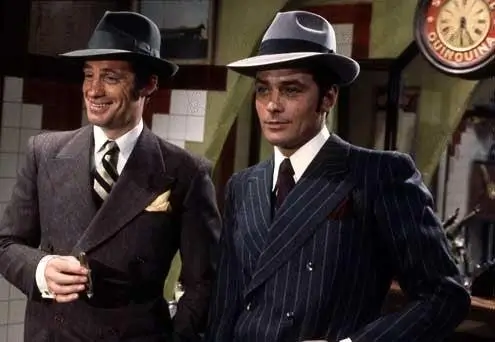
Jean-Paul Belmondo occupied a special place in Delon’s career. Both actors were among the greatest stars of French cinema, but they were very different from each other.
Belmondo was energetic, ironic, free-spirited and seemingly a hero from the streets.
Delon was elegant, mysterious, cold and dangerous.
In 1969, they appeared together in Borsalino. Two completely different screen personalities were brought together in one film, and their collaboration became one of the highlights of French popular cinema.
Interestingly, over the years, Delon and Belmondo were often mentioned side by side, even though their screen styles were almost complete opposites.
Romy Schneider — A Love That Ended but Never Truly Disappeared
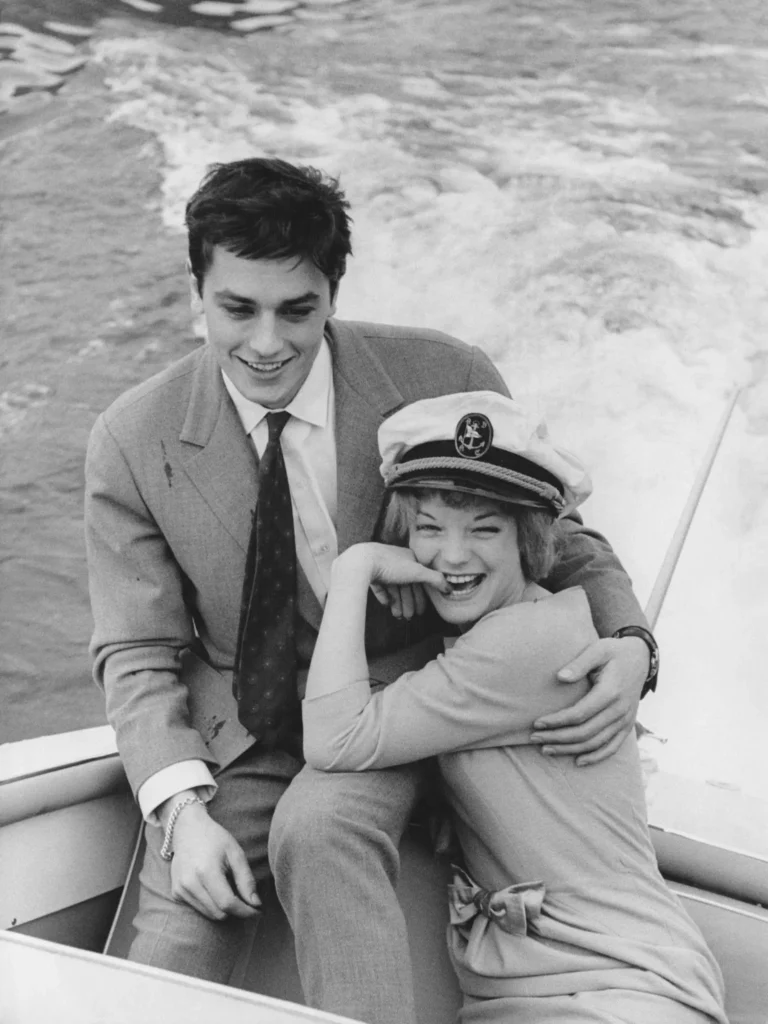
Alain Delon’s personal life became almost as famous as his films.
One of the most important women in his life was Romy Schneider. They met in 1958 and soon became one of Europe’s most famous couples. Their relationship lasted for several years, but they never married and separated in 1964.
Nevertheless, their relationship left a profound mark on Delon’s life. Even years later, Schneider’s name remained one of the most important parts of his biography.
In 1969, they reunited on screen in La Piscine (The Swimming Pool). This time, audiences were not simply watching two actors — they were watching two people who had once been in love. Their real-life history gave the tension of the film an even more unusual dimension.
When Cinema and Real Life Began to Resemble Each Other
Delon’s life was not always about success and romance.
In 1968, his name became connected to one of France’s most notorious scandals — the Marković affair.
His bodyguard, Stevan Marković, was found murdered. The investigation and the scandal surrounding it brought Delon and people close to him under intense public scrutiny. The case also developed political dimensions, while numerous rumors and theories circulated for years. Delon himself was questioned in connection with the case, but his involvement in the murder was never established.
The episode was particularly strange because Delon often played criminals and killers on screen. Now his own life had become the subject of a police investigation and scandal.
Hollywood Was Waiting for Him
Delon’s success in Europe became so great that Hollywood tried to recruit him.
He had everything an international star needed — looks, charisma, popularity and an already established image. Yet he never achieved the same level of success in English-language cinema that he enjoyed in Europe.
Delon appeared in several international productions, but ultimately his most important work remained connected to European cinema. It was in France, Italy and through his collaborations with European directors that he created the legacy that secured his place in cinema history.
And there is a certain irony in that: a man who looked like the perfect Hollywood star ultimately became most deeply preserved by European cinema.
Delon’s greatest strength — and, in some ways, his problem — was his appearance. He was so strikingly handsome that his acting abilities were often pushed into the background. Critics wrote about his cold gaze, mystery and screen magnetism. But anyone who has seen his best films knows that Delon was much more than “a handsome actor.”
In Rocco and His Brothers, he demonstrated dramatic depth.
In Plein Soleil, psychological danger.
In The Leopard, the scale of historical drama.
And in Le Samouraï, almost without words, he created a character that remained in cinema history for decades.
His filmography brought together both popular cinema and some of the most important directors of auteur cinema.
The Man Who Set His Own Rules for Growing Older
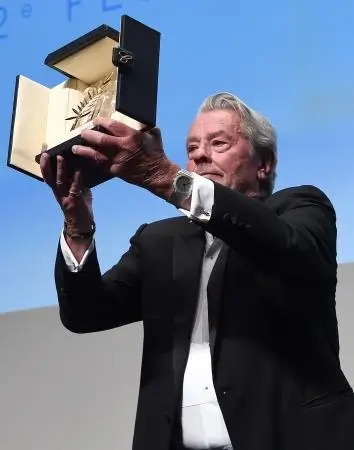
By the late 1990s, Delon had practically stopped working regularly in cinema. Later, he said that he no longer wanted to make films that might damage the reputation of his earlier career. For him, cinema was no longer simply a profession — it had become part of his life.
In 2019, when the Cannes Film Festival awarded him an honorary Palme d’Or, Delon was already 83 years old. The award recognized his entire career.
By then, his face was familiar to several generations.
People who had been young when his first films were released had grown old, yet images of Delon from the 1960s still had the same power they had decades earlier.
A Beauty That Time Could Not Defeat
Alain Delon was one of those rare actors whose youthful photographs remained cultural icons decades later.
In 2010, an image of Delon from 1968 was once again used in an advertising campaign. Delon was already 75 at the time, yet just a few seconds of old footage were enough to remind audiences of the icon of his youth. Le Monde used this episode to demonstrate just how powerful Delon’s visual legacy remained.
Perhaps this is one of the best explanations of his phenomenon: Delon was no longer simply an actor. He had become an embodiment of an era when the name of a movie star alone could bring audiences into a theater.
And Finally — Loneliness
The final years of Alain Delon’s life were completely different from his youth.
The man who had once been adored by millions of viewers spent his final years largely at his estate, surrounded by the quiet of the French countryside.
In 2019, he suffered a stroke, and his health gradually deteriorated. On August 18, 2024, a statement from his three children confirmed the death of one of the most famous names in world cinema. Delon was 88.
In accordance with his wishes, his funeral was held without a public national ceremony. He was buried at his estate in Douchy, in the same place where the graves of his dogs were located. Around 50 people attended the funeral.
And there is something symbolic about that.
The man who had spent his entire life at the center of millions of people’s attention ultimately chose the quietest place — far from cameras, journalists and noise.
Alain Delon — A Legend of an Era
We can debate his acting ability. We can discuss whether he was technically the greatest actor of his generation.
But one thing is almost impossible to deny:

Alain Delon is one of cinema’s most powerful legends.
He possessed a screen presence that could not be created through acting technique alone.
His career lasted more than six decades. He appeared in nearly 80 films and worked with directors such as Luchino Visconti, Michelangelo Antonioni, Jean-Pierre Melville, René Clément and Joseph Losey. He received an honorary Golden Bear at the Berlin International Film Festival and, in 2019, an honorary Palme d’Or at Cannes.
But perhaps the most accurate description is that Delon was both an actor and the face of an era.
His cold gaze, blue eyes, elegant suits and almost always mysterious expression became so deeply embedded in cinema culture that his death was not simply the loss of another famous actor.
An era had come to an end — an era when a movie star could simply be a star, a person whose name on a film poster could be almost as important as the film itself.
Alain Delon is gone, but the face that once first appeared on screen and became unforgettable to millions of people will remain forever in the history of cinema as the embodiment of cinematic talent, flawless charm, and the star charisma that became a symbol of an era.
The images used in the article are sourced from Wikimedia Commons and are in the public domain.
If you found the article interesting, share it with your friends and leave a comment.








When I was young, I couldn’t stand smokers (my father and mother never smoked), and Delon’s good looks couldn’t make me watch him, much less love him. But decades later, when I started watching Delon’s films, listening to his interviews, and reading the opinions of those close to him, I trusted Mireille Darci the most, because her opinion of Delon coincided with the opinion I had formed. So I can confirm that Delon’s soul was many times more beautiful than his appearance. I don’t know of another such piece of cinema history.