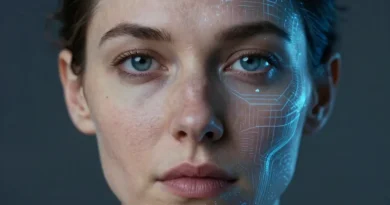
The Age of Connecting the Human – How Could It Change Humanity?
Imagine waking up in the morning without needing to reach for your phone. You read messages using nothing but your thoughts, control your computer without touching a keyboard or mouse, and a person who has lost the ability to speak communicates again—not with their voice, but with their mind.
Just a few years ago, this sounded like pure science fiction. Today, however, some of the world’s largest technology companies and leading universities are working to turn this vision into reality.
But how close are we to a future where the human brain can connect directly to the internet?
The Brain – The Most Complex “Computer”

The human brain contains approximately 86 billion neurons. These neurons constantly exchange electrical signals, enabling us to think, remember, speak, move, and experience the world around us.
If scientists can accurately interpret these electrical signals, direct communication between the brain and computers becomes possible.
This technology is known as a Brain-Computer Interface (BCI).
How Does This Technology Work?
The basic principle behind a BCI is surprisingly straightforward.
Tiny electrodes detect the electrical activity produced by neurons. Advanced software then analyzes these signals and converts them into digital commands.
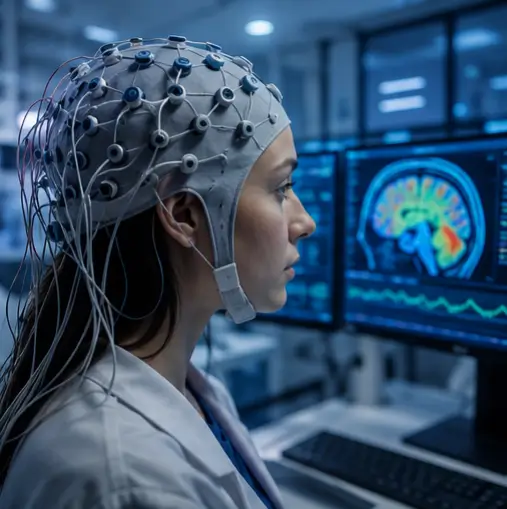
For example, a person can:
- Move a computer cursor using only their thoughts.
- Type text without touching a keyboard.
- Control a robotic arm.
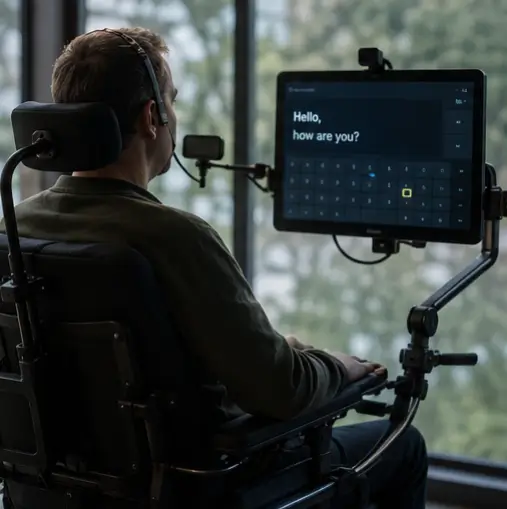
- Operate a powered wheelchair.
- In some cases, communicate through an AI-powered speech synthesizer.
In other words, the computer learns how to interpret specific patterns of brain activity associated with a person’s intentions.
Is This Really Happening?
Yes.
In recent years, several research teams have developed systems that allow people with paralysis to control computer cursors or type words using only their thoughts.
Some participants have even reached typing speeds of dozens of words per minute—an achievement that seemed almost impossible just a few years ago.
The Most Famous Project
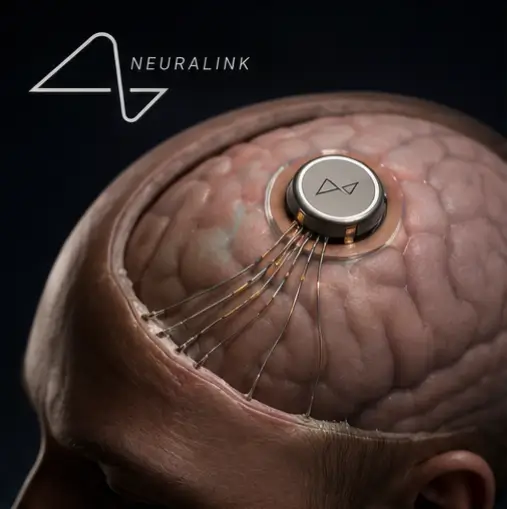
The project that has attracted the most public attention is Neuralink, founded by Elon Musk.
The company is developing a coin-sized implant placed inside the skull and connected to the brain through hundreds of ultra-thin electrodes.
Its initial goal is to help people who have lost the ability to move or speak.
In 2024, Neuralink announced the implantation of its first human patient. Later, the company demonstrated that the participant could control a computer cursor and play games using only their thoughts.
However, the technology is still in the research and development stage and is not yet available for widespread public use.
Neuralink Is Not Alone
Many people believe Neuralink is the only company working in this field, but brain-computer interface research has been underway for decades.
Companies such as Synchron and Blackrock Neurotech, along with numerous universities and research institutions, are developing different types of BCI systems.
Some rely on implants placed directly inside the brain, while others use electrodes positioned on the scalp without requiring invasive surgery.
Can Scientists Read Our Thoughts?
This is perhaps the question that concerns people the most.
The reality is far less dramatic than science fiction suggests.
Today’s BCI systems cannot freely read your thoughts, memories, or inner conversations.
Instead, they are trained to recognize specific brain signals associated with particular intentions—for example, the intention to move a cursor left or right.
In other words, technology capable of reading everything a person is thinking simply does not exist today.
Can Memories Be Stored or Uploaded?
This is another widespread misconception.
Scientists have made progress in studying memory formation in animals, and researchers continue exploring ways to improve memory through targeted brain stimulation in humans.
However, storing a person’s memories inside a computer or transferring them directly into another person’s brain remains impossible with current technology.
The Possibilities of the Future
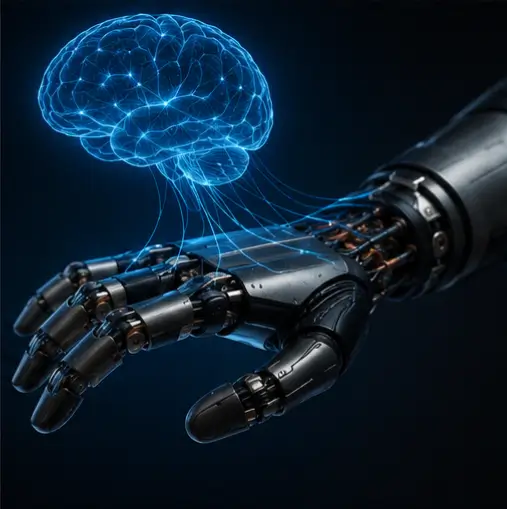
If brain-computer interfaces continue to develop safely, they could eventually make it possible to:
- Restore communication for people with paralysis.
- Control advanced prosthetic limbs naturally.
- Help restore vision for certain blind patients.
- Improve treatments for hearing loss.
- Develop more effective therapies for neurological disorders.
- Create much faster and more intuitive ways of interacting with computers.
The Ethical Challenges
The human brain is the most private part of who we are.
If these technologies become widely available, society will face difficult questions:
- Who owns the data collected from our brains?
- Could that information be stolen?
- Could someone manipulate brain signals?
- Who is responsible if a brain implant malfunctions?
- How can neural privacy be protected?
Because of these concerns, legal experts and ethicists have begun discussing a new category of human rights known as neurorights, designed to protect information generated by the human brain just as personal digital data is protected today.
How Close Are We to a Brain Connected to the Internet?
If we are talking about controlling computers or communicating through thought alone, that future has already begun, although it is currently limited mainly to research laboratories and medical applications.
If we imagine instantly downloading knowledge into our brains, browsing the internet directly through our minds, or freely sharing thoughts with other people, those ideas remain firmly in the realm of science fiction. Significant scientific, engineering, and ethical challenges still stand in the way.
Conclusion
Connecting the human brain directly to computers is no longer just science fiction—it is an active and rapidly advancing field of scientific research. The earliest successes already offer new hope for people who have lost their ability to move or communicate because of injury or disease.
Even so, we remain far from a world where everyone connects to the internet through their minds. If that day ever comes, it may represent one of the greatest technological revolutions in human history—but it will also force humanity to answer ethical questions that until recently existed only in science fiction.
If you found the article interesting, share it with your friends and leave a comment.