
World’s Progress Lost in Fire

There are events in human history that permanently altered the trajectory of civilization. One of the greatest tragedies of this kind was the destruction of the Library of Alexandria. A question often asked is: Where would our civilization be today if this knowledge had survived? Many historians and scientists believe that along with the ashes of Alexandria, we lost at least 1,000 years of scientific progress.
In this article, we will delve into the secrets held within this “internet” of the ancient world and uncover the astonishing technologies possessed by ancient scholars.
The “Internet” of the Ancient World – How Did the Library Work?
Founded in the 3rd century BCE by the Ptolemaic dynasty, the Library of Alexandria was not just a repository for books. It was a sort of “Silicon Valley” of antiquity, where scientists, thinkers, and innovators from all corners of the known world lived, worked, and conducted experiments.

The library’s administrators used an aggressive yet brilliant method to gather knowledge:
- “The Law of the Ships”: Every ship entering the port of Alexandria was legally required to be searched. If any manuscript scrolls were found on board, they were immediately taken to the library.
- Original or Copy? The scribes made an exact copy of the scroll, kept the original for the library, and returned the copy to the ship’s owner.
Through this method, the library accumulated between 400,000 and 700,000 scrolls, depending on various historical estimates. It was the greatest concentration of human memory in one place.
Lost Technologies: Heron’s Steam Engine
It is a common myth that the steam engine was invented in the 18th century during the Industrial Revolution. In reality, it already existed in Alexandria during the 1st century CE.
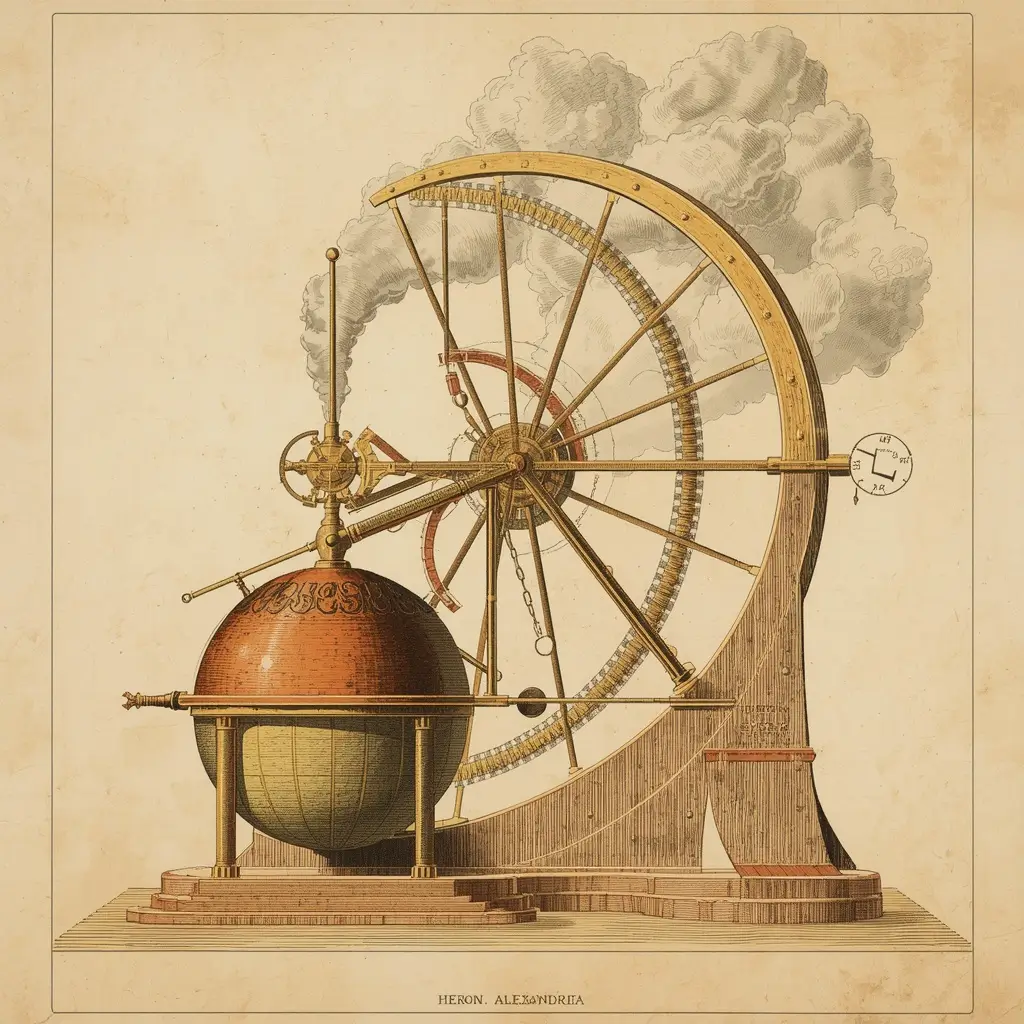
A brilliant mathematician and engineer working at the library, Heron of Alexandria, created a device called the “Aeolipile”. It was a hollow sphere that rotated using steam pressure.
Fascinating Fact: Heron’s invention, which was essentially the first steam turbine, was viewed by contemporary society merely as an “entertaining toy.” Because slave labor was cheap and abundant in the ancient world, there was no practical economic incentive to develop machinery. Had the library not been destroyed and these blueprints forgotten for centuries, the Industrial Revolution could have started 1,500 years earlier.
Beyond the aeolipile, Heron also designed the first automated doors (which opened automatically when a temple fire was lit), a mechanical puppet theater, and even a coin-operated vending machine for holy water.
Science Forgotten for 15 Centuries
Within the walls of Alexandria, discoveries were made that modern civilization only rediscovered during the Renaissance and the Age of Enlightenment:

- Eratosthenes of Cyrene: By observing geometric shadows and the angles of wells, he calculated the circumference of the Earth with near-perfect accuracy. He also suggested that by sailing west, one could reach India—though he noted an unknown continent might block the path (an idea Columbus stumbled upon 17 centuries later).
- Aristarchus of Samos: He was the first to propose the heliocentric model, arguing that the Earth revolves around the Sun, not the other way around. This idea was written on papyrus in Alexandria long before Copernicus and Galileo.
- Herophilus of Chalcedon: The father of anatomy, who performed the first systematic dissections of the human body. He concluded that the brain, not the heart, is the center of intelligence and mapped out the nervous system.
Who Burned the Library of Alexandria? (A True Detective Story)
Popular culture often implies that the library burned down in a single, catastrophic fire. In reality, it was a slow series of disasters spanning several centuries. The list of suspects includes:
1. Julius Caesar (48 BCE)
During the Alexandrian War, Caesar ordered his own fleet to be burned in the harbor to prevent it from falling into enemy hands. The fire spread from the docks to the coastal quarters of the city. It is believed that a significant section of the library or nearby warehouses containing 40,000 scrolls was severely damaged during this event.

2. Emperor Aurelian (270s CE)
During a brutal siege to recapture the city from a rebellion, Aurelian’s forces completely leveled the Brouchion district—the exact quarter where the main library building stood.
3. Religious Fanaticism (391 CE)
By decree of Emperor Theodosius I, all pagan temples were ordered destroyed. Led by Patriarch Theophilus, a mob destroyed the Serapeum—the “daughter” branch of the Library of Alexandria, which housed thousands of irreplaceable backup scrolls. It was during this era of rising fanaticism that Hypatia, the last great female mathematician and philosopher of the city, was brutally murdered, symbolizing the end of ancient science.
What Did We Ultimately Lose?
Only fragments of Alexandria’s treasure have reached us today—largely preserved through later Arabic translations and Byzantine copyists.
We permanently lost the vast majority of Aristotle’s works, hundreds of dramas by Sophocles and Euripides, and most importantly, the millennia-old chronicles of the Babylonian, Egyptian, and Phoenician civilizations. These records could have shed light on the true, perhaps shocking, primordial history of humanity.
The ashes of the Library of Alexandria serve as a stark reminder that progress is never guaranteed. Knowledge that takes millennia to build can be wiped out in a matter of hours by ignorance and fanaticism.
If you found the article interesting, share it with your friends and leave a comment.