
Julius Caesar, who changed the world.
Almost two millennia have passed since the death of Julius Caesar, yet he still remains one of the most important figures in world history. His military and political achievements changed ancient Rome and left a legacy that has survived to this day. Below is the most important legacy of the famous Roman military commander and political figure.
1. Caesar expanded Roman rule into Europe.

In 58 BC, after being appointed governor of Gaul, the northern territory of Rome, Caesar expanded the borders of the Roman Republic across Europe—up to the shores of the Atlantic Ocean and the English Channel. During the bloody eight-year Gallic Wars, his legions conquered local tribes in the territories of modern France, Belgium, and Switzerland.
In 55 BC, Caesar’s army built a large wooden bridge over the Rhine River in just 10 days, which represents an engineering marvel in military history. After Roman troops crossed such a vast water barrier for the first time, they began subduing Germanic tribes that threatened Rome’s eastern Gallic territories. At the end of the same year, the Roman general carried out the first expedition across the English Channel. These first invasions of Britain laid the foundation for Rome’s eventual conquest of much of the island.
2. “Crossing the Rubicon”

With skillful tactics on the battlefield and strong determination in combat, Julius Caesar earned immense loyalty and respect from his soldiers, but at the same time gained a powerful enemy in Pompey, who had been his former political ally in the First Triumvirate that effectively ruled Rome. Pompey’s supporters in the Roman Senate demanded that Caesar disband his army and return to Rome as a private citizen, but he refused, which became the basis for civil war in Rome.
In 49 BC, Caesar boldly crossed the Rubicon River with his legions, which separated Gaul from Roman territory, and advanced toward Rome from the north. Forces supporting Caesar on one side and Pompey on the other fought each other across Spain, Greece, and North Africa. Although Caesar’s legions were outnumbered, in 48 BC they defeated Pompey’s army in the decisive Battle of Pharsalus in Greece, forcing Pompey to flee to Egypt. However, before reaching shore, he was killed by order of the young pharaoh Ptolemy XIII, hoping to gain Caesar’s support in the civil war against his co-ruler and sister, Cleopatra VII.
3. Caesar placed Cleopatra on the Egyptian throne.

At the beginning of 47 BC, Roman legions entered Egypt, and in the Battle of the Nile, Caesar’s forces defeated Ptolemy’s army. After the young king drowned in the Nile while fleeing the battle, Caesar appointed Cleopatra and her 12-year-old half-brother Ptolemy XIV as co-rulers, although real power belonged to the queen.
Ptolemy made a serious mistake. When he presented Pompey’s severed head to Caesar upon his arrival in Alexandria, the reaction, instead of gratitude, was terrible. Caesar immediately executed Pompey’s killers and supported Cleopatra in the Egyptian civil war. According to the ancient historian Plutarch, Caesar moved the 21-year-old Cleopatra into the royal palace, where she lived secretly. During the siege of Alexandria, the pair began a romance that lasted six months. When Caesar returned to Rome, Cleopatra gave birth to a boy, who was presumably Julius’s son. The queen named him Ptolemy XV, but Alexandrians mockingly called him “Caesarion,” “little Caesar.” In 46 BC, Cleopatra and her infant son moved to a villa on the banks of the Tiber River in Rome. Caesar frequently visited them there, violating Roman law on bigamy. After Caesar’s assassination, Cleopatra returned to Egypt and later formed a romantic relationship and alliance with Caesar’s deputy, Mark Antony. The couple later committed suicide after Augustus defeated their forces in 31 BC.
4. He ruled Rome as a dictator
After the war with Pompey, Caesar gained enormous power. With strong support from the army and the non-elite citizens (plebeians), he was appointed dictator of Rome for 10 years in 46 BC, and the following year declared himself “dictator for life.” His large-scale reforms—such as distributing property to retired soldiers, allocating land to poor citizens, and canceling debts—were very popular among former soldiers and the lower and middle classes.
Caesar’s reforms angered the elite, as did his dismissive attitude toward the Roman Senate and republican traditions. A personality cult formed around him, as he minted coins with his image, celebrated his birthday as a public holiday, and ruled the Senate from a golden throne.
5. His assassination led to the fall of the Roman Republic and the rise of the Roman Empire.
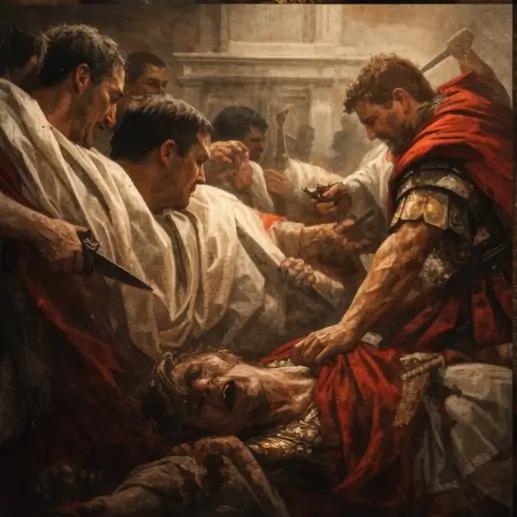
Caesar’s autocratic rule laid the foundation for the establishment of the Roman Empire. Dozens of senators, who believed that Caesar’s concentration of absolute power threatened the democratic institutions of the Republic, planned his assassination, which they carried out in March 44 BC. However, instead of saving the 400-year-old Roman Republic, the dictator’s murder accelerated its collapse.
In the struggle against the dictator, the senators inadvertently created an emperor. Caesar’s heir—Augustus—defeated all his rivals in a long civil war and, after gaining the position of supreme leader of Rome, killed all of Caesar’s assassins and destroyed the republicans, after which Caesar was effectively declared a god, laying the foundation for the formation of the autocratic Roman Empire, which lasted about five centuries.
6. He introduced the modern calendar
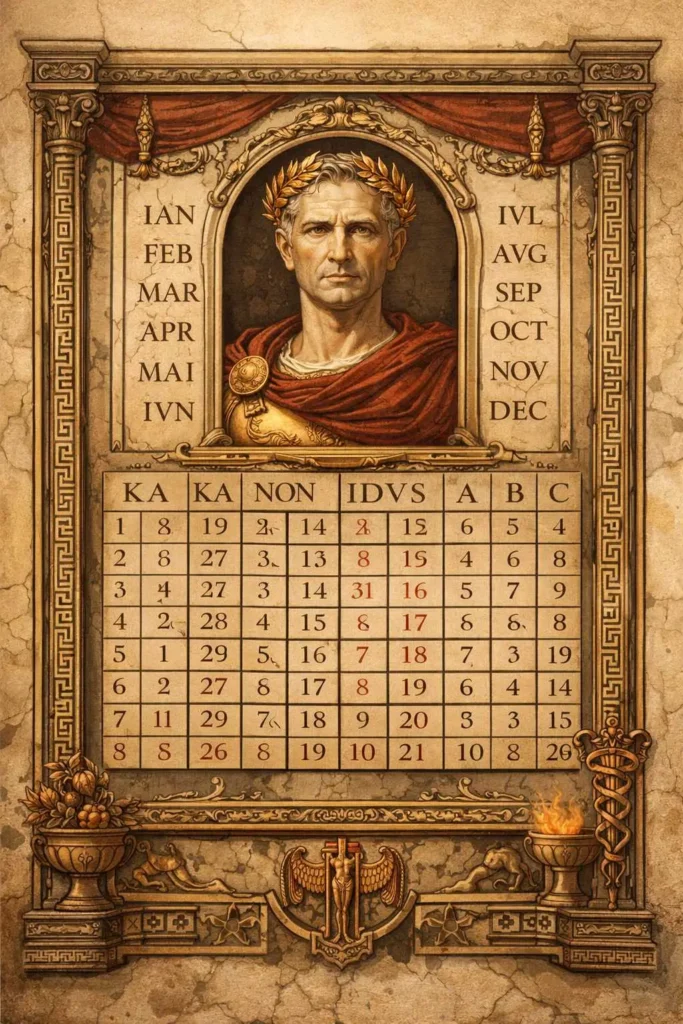
Caesar’s power was so great that he decided to change the system of timekeeping. The traditional Roman calendar, based on a 355-day lunar year, required constant adjustment because it was not synchronized with seasons and festivals. With the help of the Greek mathematician and astronomer Sosigenes of Alexandria, Caesar introduced the Julian calendar, based on a 365¼-day solar year, with a “leap day” added every four years.
In 46 BC, due to calendar reform, the year lasted 445 days before Caesar’s system came into effect on January 1, 45 BC. The Julian calendar dominated much of the Western world for 16 centuries. Since the solar year is slightly less than 365¼ days, the Julian calendar gained one extra day every 131 years. By the 1500s, the calendar lagged behind the seasons by 10 days. In 1582, Pope Gregory XIII reformed the calendar, removing 10 days and establishing that only one in every four years would be a leap year. The Julian calendar is still used today within some Orthodox churches in Europe.
If you found the article interesting, share it with your friends and leave a comment.