
The life and mysterious death of Napoleon.
After his defeat by the English at the Battle of Waterloo, the former emperor was placed on a distant island, in a bleak and isolated house.
Napoleon Bonaparte is one of the most famous and popular figures in the history of humanity. His remarkable military successes and large-scale reforms in legislation and the formation of state systems across the entire European continent are astonishing, but equally unusual and shrouded in mystery are the final years of his life—spent in humiliating exile, his mysterious death at the age of 51, and the strange chain of events after his death.
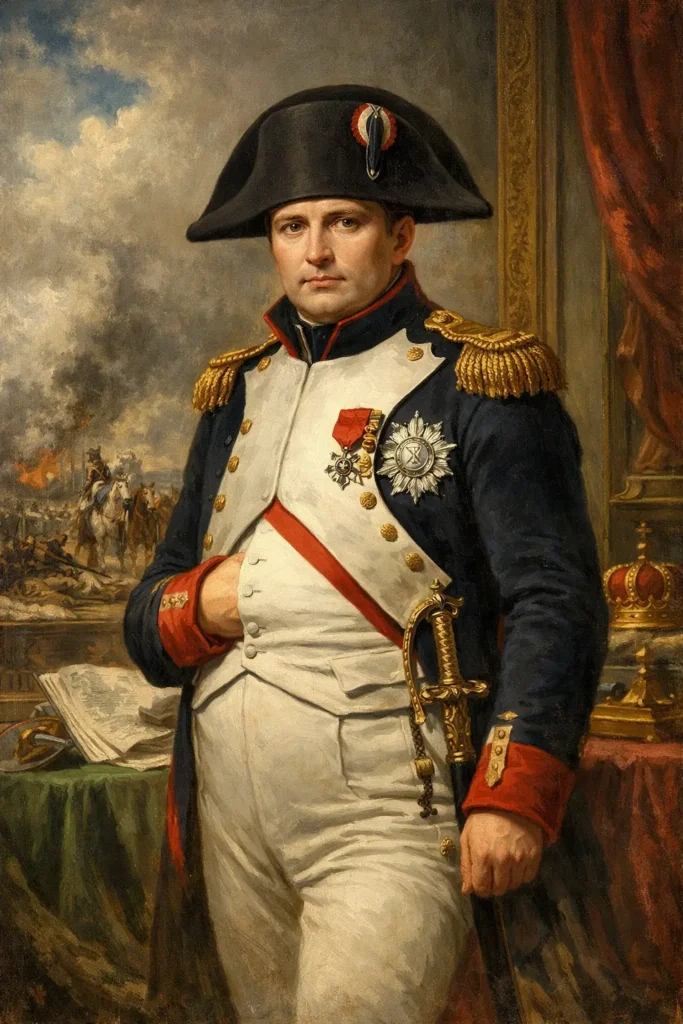
In 1815, after his final defeat at the Battle of Waterloo, Napoleon abdicated the throne and surrendered to the British. Instead of execution, to avoid turning him into a martyr, Britain exiled him to one of the most isolated places on Earth—Saint Helena Island in the South Atlantic Ocean, controlled by Britain.
Exile on Saint Helena Island
Saint Helena is a small island, about 10 × 5 miles in size, with jagged cliffs and a harsh landscape. Initially, for two months, Napoleon lived in the house of his former friend William Balcombe, but then he was moved to nearby Longwood House—a ruined, damp, and mold-covered building.
His servants complained about the cold, damp floors, illnesses, and poor food. A member of Napoleon’s entourage, Count de Las Cases, described Longwood House as “a miserable hut of a few square feet.”

The island was also full of rats, which European political satirists used to mock the defeated emperor. In German caricatures, a “battalion” of rats was depicted as his courtiers, while in French satirical journals, Napoleon is shown sleeping in a tent while rats on the shore plan a rebellion against him with the caption: “Even the rats don’t want him.”
Napoleon’s condition worsened further when the new British governor on the island, Hudson Lowe, imposed strict control. He restricted the former emperor’s movement, monitored correspondence, and ordered British officers to see Napoleon several times a day to prevent escape.
Napoleon responded in his own way: he closed the shutters, made small holes in them to look outside, and designed sunken garden paths so that it would be harder for officers to notice him. Despite the prohibition against receiving imperial honors, Napoleon continued to observe royal protocol—his male servants wore military uniforms, while the women were dressed in luxurious clothing.
In exile, he engaged in various activities: dictating memoirs, writing a book about Julius Caesar, learning English, and often playing cards. So often that several versions of solitaire (also known as “patience”) were named after him.
Deterioration of health and death
Over time, the living conditions and especially the lack of physical activity had a severe impact on Napoleon’s health. He suffered from stomach pain, constipation, vomiting, and general weakness. By February 1821, almost four years after arriving on the island, Napoleon realized that his end was approaching.
He reconciled with the Catholic Church, even though he had once held the Pope captive. He made confession and received the last rites. On May 5, 1821, Napoleon Bonaparte died at the age of 51.
What killed Napoleon Bonaparte?
Shortly after his death, his doctor Francesco Antommarchi performed an autopsy. The heart and intestines were removed and placed in sealed containers, as was customary for monarchs. However, it is strange that Antommarchi also removed Napoleon’s penis—the reason remains unknown to this day.

This body part was taken from the island by a priest and then passed among various owners for years. Eventually, in 1927, it was exhibited in a French art museum in New York, where TIME magazine described it as a “piece of damaged lace.” Thus they mocked a man who once held almost all of Europe in his hands.
So what killed “Old Bony,” as the English liked to call him? This has been a subject of historical debate and medical science for the past 200 years. According to Antommarchi, the cause of Napoleon Bonaparte’s death was stomach cancer. However, in 1961, a Swedish amateur toxicologist suggested that Napoleon had been poisoned with arsenic and suspected one member of his French entourage.
Other researchers note that arsenic was widely used in everyday life at that time, in various household activities, and people were constantly exposed to it. Some suggest that the cause of death was a peptic ulcer or again stomach cancer.
Interest in the figure of Napoleon Bonaparte has not diminished for more than two centuries. And it will remain the subject of many studies and research by historians and scientists from various fields for a long time to come.
If you found the article interesting, share it with your friends and leave a comment.