Hieronymus Bosch – The Artist Whose Paintings Have Challenged Humanity to Solve Their Mysteries for Over 500 Years
Introduction
Imagine an artist who, in the 15th century, painted creatures so bizarre that many people today compare them to scenes from fantasy films, nightmares, or even images generated by artificial intelligence. Strange monsters, human-animal hybrids, giant fruits, people tortured by musical instruments, cities consumed by fire, and visions of Hell so haunting that they continue to astonish and disturb viewers centuries later.

This artist was Hieronymus Bosch (c. 1450–1516), a Dutch master whose imagination was centuries ahead of its time.
For more than five hundred years, historians, art historians, theologians, psychologists, and scientists have studied his paintings. Yet one question remains unanswered:
What was Bosch really trying to tell us?
Was he a deeply religious man warning humanity about the consequences of sin? Was he simply an artist with an extraordinary imagination? Or did he hide symbols in his paintings whose meanings have been lost over the centuries?
The Man We Know Surprisingly Little About
Bosch’s real name was Jheronimus van Aken.
He adopted the name Bosch from his hometown, ‘s-Hertogenbosch, in the Netherlands.
Ironically, despite being one of the most mysterious artists in history, very little is known about his personal life.
We still do not know:
- What his daily life was like.
- How he learned to paint.
- What he thought about his own works.
- Why he created such extraordinary creatures.
Almost none of his personal letters have survived, and no diary has ever been discovered.
As a result, scholars have been forced to understand Bosch mainly through his paintings.

Europe in an Age of Fear and Faith
Bosch lived during the late 15th century, a time when religion shaped almost every aspect of European life.
People firmly believed in:
- Heaven
- Hell
- Demons
- Miracles
- Divine punishment
The devastation caused by the Black Death, wars, and recurring famine left society living in constant fear.
It was within this world that Bosch created his extraordinary art.
Yet his vision of Hell was unlike anything anyone had seen before.
The Artist Who Turned Monsters into Reality
Bosch’s paintings are filled with creatures that continue to amaze viewers today.
Among them are:
- Fish with human legs.
- Birds swallowing people whole.
- Giant tree-like humans.
- Sinners tortured on enormous musical instruments.
- Half-human, half-animal creatures.
- Giant strawberries.
- Monsters emerging from eggs.
Perhaps the most remarkable detail is that almost none of these beings resemble one another.
It is as though Bosch invented an entirely new universe every time he picked up his brush.
The Painting That Changed Art History
If you could see only one work by Bosch, it should undoubtedly be The Garden of Earthly Delights.
This magnificent triptych is considered one of the greatest mysteries in the history of art.
When closed, it depicts the Creation of the World.
When opened, however, the viewer enters a completely different reality.

The Left Panel – Paradise

The left panel portrays:
- God
- Adam
- Eve
- Exotic animals
- Fantastic plants
At first glance, everything appears peaceful.
But a closer look reveals predators already hunting their prey and strange creatures behaving in unusual ways.
Some scholars believe Bosch was suggesting that evil had already begun to emerge even in Paradise.
The Center Panel – Humanity’s World
Here begins the painting’s greatest mystery.
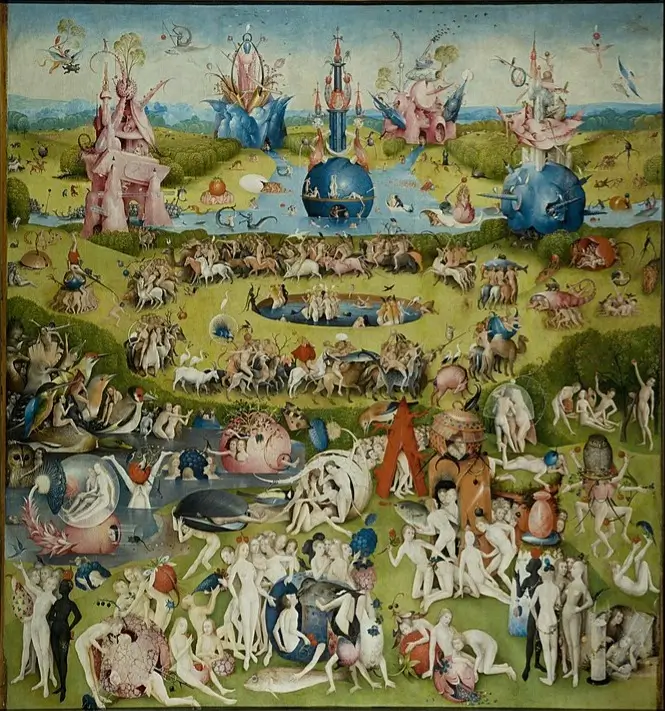
Hundreds of naked figures swim, play, gather together, and interact with extraordinary animals while surrounded by enormous fruits.
The giant strawberries, cherries, and other fruits have fascinated researchers for centuries.
Some believe they symbolize the fleeting nature of earthly pleasure.
Others interpret them as symbols of temptation, sensuality, and human desire.
No explanation has ever been universally accepted.
The Right Panel – Hell

This section transformed Bosch into a legend.
Here, sinners suffer bizarre and terrifying punishments.
One of the painting’s most famous figures is the mysterious Tree Man—a strange being whose body resembles a hollow tree.
Inside his body people gather, while a large disk-like structure rests upon his head.
For centuries scholars have debated:
Could this be Bosch’s own self-portrait?
Or is it simply one of Hell’s rulers?
No one knows for certain.
Music as Punishment
In Bosch’s Hell, enormous musical instruments become instruments of torture.
One particularly curious detail has fascinated modern researchers.
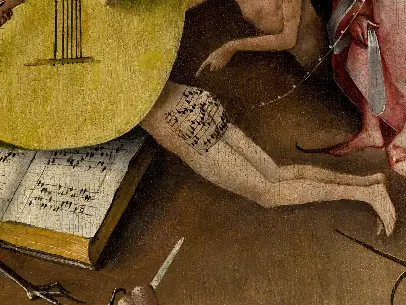
Notes painted on the body of one of the condemned figures were transcribed into modern musical notation, allowing musicians to perform what has become known as the “music from Hell.”
The performance quickly spread across the internet and attracted millions of viewers.
However, most art historians caution that there is no historical evidence proving Bosch intended these markings to represent an actual musical composition.
Was Bosch the Greatest Visionary of His Time?
Some psychologists argue that only an exceptionally creative mind could have imagined such extraordinary worlds.
Others believe Bosch simply possessed an unparalleled knowledge of medieval religious texts, folklore, symbolism, and moral teachings.
More speculative theories claim he experienced mystical visions, possessed secret esoteric knowledge, or even witnessed realities beyond ordinary human perception.
Yet none of these ideas has been supported by convincing historical evidence.
Why Bosch Still Fascinates the Modern World

Today Bosch’s influence extends far beyond museums.
His strange and imaginative worlds continue to inspire filmmakers, video game designers, musicians, writers, and digital artists.
Many viewers are astonished to discover that these surreal images were painted more than five centuries ago.
His work often feels surprisingly modern, almost as though it belongs to the twenty-first century rather than the fifteenth.
Conclusion
Hieronymus Bosch left behind far more than paintings—he left behind mysteries.
His masterpieces invite us to reflect on human nature, temptation, fear, morality, imagination, and the consequences of our choices.
Perhaps that is the true mark of genius.
Five hundred years after his death, people still stand before his paintings asking the very same questions that puzzled his contemporaries.
And perhaps those questions will never be answered.
The images used in the article are sourced from Wikimedia Commons and are in the public domain.
If you found the article interesting, share it with your friends and leave a comment.