Raphael — The Genius Who Changed the History of Art in 37 Years
When we talk about the greatest artists of the Italian Renaissance, three names almost always appear together — Leonardo da Vinci, Michelangelo, and Raphael. Leonardo became known as a universal genius — an artist, scientist, and inventor; Michelangelo brought the power and drama of the human body to an extraordinary level; while Raphael seemed to accomplish something entirely different — he transformed beauty, harmony, and serenity into an artistic ideal that remained influential for centuries. What is most astonishing is that he achieved all of this in just 37 years. Raphael was born in 1483 and died in 1520, yet the world he created continued to influence the development of European art for centuries.
Childhood in Urbino and His First Teacher — His Own Father

Raphael, whose full name was Raffaello Santi, was born in 1483 in Urbino, one of the important cultural centers of Renaissance Italy. His father, Giovanni Santi, was also a painter and worked at the court of the Duke of Urbino. Art was therefore never a foreign world to Raphael — he essentially grew up surrounded by it. His early artistic education most likely began in his father’s workshop, while life at the Urbino court gave him an opportunity to encounter the cultural and intellectual world of his time from an early age.
But tragedy came very early to Raphael’s childhood. His father died when the boy was only 11 years old. For any child, losing a parent at such an age would have been devastating, but in Raphael’s case he also lost the professional environment in which he had been raised. Despite this, the young artist’s talent was so remarkable that he soon entered one of the most important artistic circles in central Italy. His early development was particularly influenced by Pietro Perugino, whose style Raphael absorbed with extraordinary speed. His work became so refined that contemporaries could sometimes find it difficult to distinguish the paintings of Perugino from those of his young pupil.
The Young Artist Who Found His Own Style Very Quickly
Raphael’s extraordinary talent was not limited to technical skill. One of his most important qualities was his ability to learn from others without simply copying them. This characteristic shaped his entire career. Raphael did not attempt merely to reproduce the style of a single teacher. He observed different artists, learned from them, and then combined what he had learned into his own artistic language.
By around 1500, Raphael was already regarded as an independent master. During the following years he worked in central Italy, particularly in Florence, where one of the most important stages of his career began.
Florence was one of the principal centers of the Italian Renaissance at the time. Here Raphael encountered the works of Leonardo da Vinci, and their influence on his artistic development became clear. Leonardo’s soft transitions of light and shadow, natural grouping of figures, expressive faces, and innovative approach to composition were important lessons for the young artist. Yet Raphael did not simply imitate Leonardo. He incorporated these ideas into his own style and gradually created the harmonious, calm, and balanced form of painting that would become his trademark.
Three Geniuses in the Same Era
Raphael’s life is especially fascinating because he found himself at the center of one of the most extraordinary periods in European cultural history. Leonardo da Vinci, Michelangelo, and Raphael were all active during the same broad era.
Their approaches were very different. Leonardo observed the natural world with the curiosity of a scientist. Michelangelo expressed strength, tension, and almost supernatural physical energy. Raphael’s world, by contrast, seemed to place everything in harmony — people, architecture, colors, movement, and space. This is why Raphael became associated with the ideals of the High Renaissance, in which beauty and harmony were meant to come together in a perfectly balanced composition.
Yet Raphael was the youngest of the three. While Leonardo and Michelangelo had already established formidable reputations, Raphael was still rising. Then his life changed completely.
Rome — Where Raphael Became a Legend
In 1508, when Raphael was only 25, Pope Julius II invited him to Rome. He was commissioned to work on the decoration of the papal apartments. This was no ordinary commission. Working for the papal court represented an enormous opportunity for an artist of the period, and Raphael made full use of it.
In Rome, Raphael’s art became increasingly monumental. He encountered the art and architecture of ancient Rome directly, and his work acquired a greater sense of scale. At the same time, he was aware of Michelangelo’s work and absorbed aspects of his powerful, physical style. Ultimately, however, Raphael transformed what he learned from both great masters into a distinctive artistic language of his own.
It was in Rome that he created the works that would make his name immortal.
The School of Athens — When an Entire World of Philosophy Appeared on One Fresco
Raphael’s most famous work is probably The School of Athens. The fresco presents a vast gathering of philosophers and thinkers from the ancient world. At the center stand Plato and Aristotle, surrounded by representatives of different philosophical traditions.
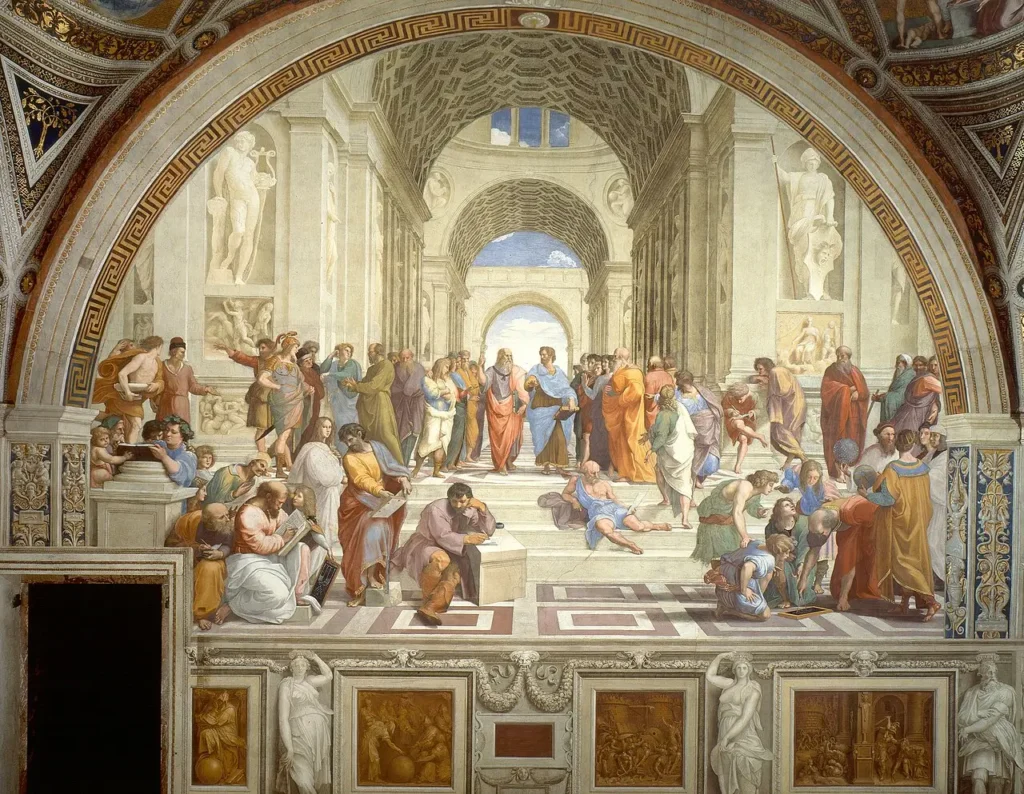
At first glance, it may seem to be simply a large gathering of ancient philosophers, but the idea behind the fresco is much broader. Raphael created an imaginary meeting of the intellectual world — people who lived in different centuries are brought together in a single space. The Vatican Museums describe The School of Athens as Raphael’s first major fresco in the Vatican rooms and emphasize its complex intellectual program and the importance of Raphael’s fresco technique.
The fresco also contains another fascinating detail. Art historians and popular accounts have often suggested that some of the figures resemble famous people from Raphael’s own era. One of the best-known interpretations is that Plato’s face resembles Leonardo da Vinci. Some figures have also been associated with Michelangelo. Such identifications, however, should be treated cautiously, because not all of these theories are historically proven.
Nevertheless, the idea itself is extraordinary. The young Raphael effectively brought together an entire intellectual history on one wall, combining the ancient world with the greatest minds of his own age.
Raphael and Michelangelo — Rivalry or Influence?
The relationship between Raphael and Michelangelo is one of the most fascinating subjects of Renaissance history. They had very different personalities and artistic approaches, and popular accounts have often portrayed them as rivals.
Michelangelo’s art was energetic, powerful, and dramatic. Raphael’s was calmer, more balanced, and harmonious. Yet their influence on each other was not entirely one-sided. Raphael studied Michelangelo’s work and learned from it.
This is an important aspect of Raphael’s genius. His greatness did not come from learning nothing from others. On the contrary, one of his greatest strengths was his ability to absorb different influences rapidly and transform them into something uniquely his own. His art was therefore neither simply an extension of Leonardo’s nor an alternative to Michelangelo’s. It was a third path that developed alongside the work of both masters.
Raphael Was More Than a Painter
In Rome, Raphael’s activities extended far beyond painting. He worked on monumental frescoes, produced drawings and panel paintings, designed compositions for tapestries, and became involved in architecture. His career expanded so rapidly that he eventually became not only a painter, but also the head of a large workshop and an important cultural figure.
His workshop itself is a fascinating phenomenon. The enormous number of commissions he received could not have been completed by one person alone, so Raphael worked with numerous assistants and collaborators. Modern art historians increasingly emphasize this collective aspect of his career. His workshop functioned as a large collaborative system in which his ideas were executed by other artists as well. After his death, his closest collaborators and followers continued his projects and contributed to the development of the artistic style that followed the High Renaissance.
Raphael also found an effective way to spread his work beyond the places where his paintings were physically located. Engravings were made from his designs and circulated much more widely than the original frescoes and paintings. This helped spread his artistic ideas throughout Europe.
The Madonnas — Raphael’s Vision of Beauty

Images of the Virgin Mary and the Christ Child occupy a special place in Raphael’s work. His Madonnas are not simply illustrations of religious themes. They combine religious meaning with human warmth, serenity, and maternal affection.
During his Florentine period, Raphael became particularly famous for these compositions. His figures are often calm and idealized, yet they convey a deeply human relationship — a mother’s gaze, a child’s movement, and physical closeness between the figures. This combination of religious subject matter and human emotion helped make Raphael’s Madonnas so influential.
The Alba Madonna is a good example. The Virgin Mary is shown with the Christ Child and Saint John the Baptist, while the interaction between the figures has the intimacy of a natural family scene. The religious meaning and human emotion are no longer separate; they become part of the same composition.
La Fornarina — The Woman Who Became a Mystery

Raphael’s story is not limited to his masterpieces. His personal life has also generated numerous legends. One of the most famous examples is La Fornarina, a portrait of a woman whose identity became associated with various stories about Raphael’s private life.
For centuries, there has been speculation that the woman portrayed may have been Raphael’s lover. But it is important to distinguish historical evidence from later legend. Much of what has been written about Raphael’s personal relationships was created or embellished after his death, and not all of it can be confirmed.
That is precisely what makes La Fornarina so interesting. Rather than simply presenting the story as established fact, it is more accurate to see it as an example of the difference between documented history and later interpretation.
Contemporary accounts also suggest that Raphael was regarded not only as a great painter but as an exceptionally charismatic and sociable man. By the final years of his life, he had achieved considerable influence and social status.
How Could a Man Become So Influential at Only 37?
This is perhaps the most astonishing aspect of Raphael’s life. Looking at his biography today can feel like reading the careers of several different people: he grew up in the household of a painter, became an independent master at a young age, studied the influence of Leonardo in Florence, was summoned to Rome by the pope at just 25, created monumental frescoes in the Vatican, established a large workshop, became involved in architecture, and developed effective ways to spread his artistic designs.
His success was undoubtedly based on extraordinary talent, but talent alone would not have been enough. Raphael had a remarkable ability to learn quickly, collaborate with others, and combine different influences into a coherent artistic style. This is one of the reasons his career developed so rapidly.
The Final Masterpiece and a Sudden Death
Raphael’s life came to an abrupt end in 1520. He was only 37 years old.
The exact cause of his death has been debated, and different historical accounts have offered different explanations. Modern researchers continue to examine the available evidence, so not every popular version of his death should be treated as established fact.
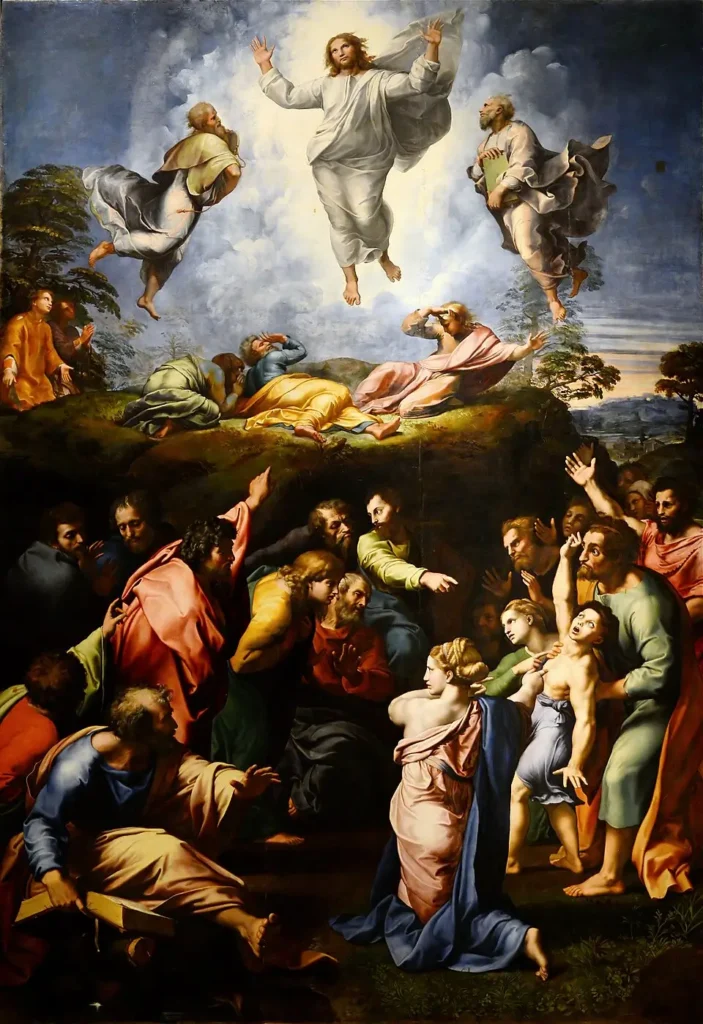
One thing, however, is certain: Raphael died remarkably young, at a time when his career was still developing. One of his final and most important works was The Transfiguration. It is particularly significant because it represents the mature stage of Raphael’s artistic development and combines his characteristic harmony with a more dramatic and emotionally intense scene.
Raphael’s death was a major event for his contemporaries. A man who had lived for only 37 years had already become such an important figure that he was buried in the Pantheon in Rome. His connection with the ancient monument was especially appropriate: during his final years, Raphael had also been involved in the study and preservation of Rome’s ancient heritage.
Thirty-Seven Years — and a Legacy That Lasted for Centuries
This is where Raphael’s story becomes particularly remarkable. His life ended, but his influence was only beginning.
His style shaped the way generations of artists, academies, and art historians understood artistic perfection. His compositions were copied, reproduced, studied, and reinterpreted. His influence on European academic art remained exceptionally strong for centuries.
His impact can even be seen in the nineteenth century, when the English Pre-Raphaelite Brotherhood deliberately chose a name referring to Raphael. Their name reflected their desire to return to artistic traditions that, in their view, existed before Raphael’s influence became dominant. The movement itself demonstrates how powerful Raphael had become as a symbol in European art history.
Perhaps the greatest strength of Raphael’s art lies in the fact that his paintings are not merely demonstrations of technical skill. They possess a sense of balance that can create an immediate feeling of calm. His figures seem to live in a complicated world, yet there is little chaos within the composition. Everything appears connected.
Why Did Raphael Remain Alongside Leonardo and Michelangelo?
Raphael’s place beside Leonardo and Michelangelo cannot be explained simply by saying that he was another talented painter. His uniqueness lay elsewhere.
Leonardo sought to understand the mysteries of the natural world. Michelangelo expressed human strength and inner tension. Raphael created a world in which everything seemed to find its proper balance. His art presents not a chaotic and conflicting world, but an ideal form of the world — perhaps the way human beings dream it could be.
And that is what makes his story so extraordinary: Raphael was given an unusually short life, yet in those few decades he created a legacy whose influence has continued for more than five centuries.
At the age of 37, his life ended, but his story did not. Today, when we look at The School of Athens, his Madonnas, or The Transfiguration, we are still seeing the ideas of a young artist who managed to establish his place beside Leonardo and Michelangelo.
Perhaps the greatest paradox of Raphael’s life is this:
He did not live long enough to grow old, but he lived long enough to become immortal.
Main Sources
The factual information in this article has been checked against authoritative art institutions, including:
The images used in the article are sourced from Wikimedia Commons and are in the public domain.
If you found the article interesting, share it with your friends and leave a comment.